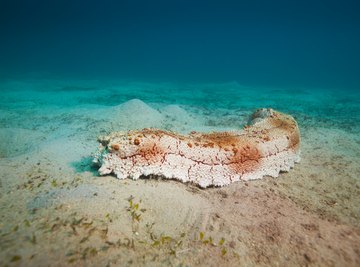
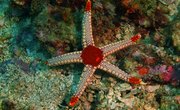
Sea cucumbers are striking members of the phylum Echinodermata, a collection of some 7,000 species of mostly marine invertebrates that also includes sea stars and sea urchins. Sometimes bizarre to human eyes, sea cucumbers have adapted to a mostly slow-moving life at or near the bottom of the ocean. Often colorful, these diverse creatures of worm-like motion and tentacled mouth are perfectly at home within the sediment and murky waters well below the surface.
Locomotion
The great majority of sea cucumbers spend their lives roaming the seafloor, and this preferred habitat has shaped their locomotive adaptations. Most kinds of sea cucumbers possess what are called tube feet, or podia. These suction-capped appendages, typically arranged in three rows below and two rows above, help the creature scrawl along. Other species lack tube feet and instead wriggle along with regular contractions and elongations of their bodies. A minority of sea cucumbers will travel by active swimming in the water column.
Feeding
Sea cucumbers possess a ring of tentacles around their mouths, which are actually modified tube feet. Some species may have 30 mouth-tentacles, though in most there are typically less. These tendrils assist the sea cucumber in acquiring food items, usually tiny organisms or carrion bits. Tentacle structure varies and affects feeding behavior. Certain sea cucumbers ensconce themselves in pre-existing burrows of the substrate and extend their tentacles into the water column to snatch up prey. Others are suspension feeders, attracting drifting edible bits with mucus-covered tentacles. Some sea cucumbers actually consume ocean-bottom sediment, gleaning food particles for digestion and excreting the non-edible muck. According to “The International Wildlife Encyclopedia” (2002), some coral reefs may see 60 tons of sand processed through sea-cucumber bodies annually.
Defense
Sea cucumbers have evolved certain adaptations and behaviors to deal with potential threats. Some simply whip about with uncharacteristic vigor when confronted with a predator. Others extrude masses of adhesive white threads from their anuses to entangle attackers, or even parts of their own internal anatomy, which may be re-grown if the sea cucumber survives the encounter.
Internal Adaptations
The interiors of sea cucumbers possess some adaptations common to echinoderms and others unique to the class. Their musculature primarily consists of longitudinal and circular muscles controlling their movements, including a basic version of circulation by which the coelomic fluid is distributed through the body cavity, or coelom. The animals breathe through what are known as “respiratory trees,” branching organs that distribute water drawn in by the opening of the sea cucumber’s cloaca.
References
About the Author
Ethan Shaw is an independent naturalist and freelance outdoors/nature writer based in Oregon. He holds a B.S. in Wildlife Ecology and a graduate certificate in G.I.S. from the University of Wisconsin-Madison. His primary interests from both a fieldwork and writing perspective include landscape ecology, geomorphology, the classification of ecosystems, biogeography, wildlife/habitat relationships, and historical ecology. He’s written for a variety of outlets, including Earth Touch News, RootsRated, Backpacker, Terrain.org, and Atlas Obscura, and is presently working on a field guide.