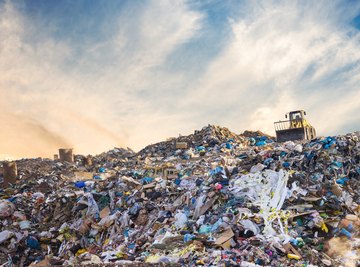

The Earth recycles everything and reuses the material from dead plants and animals to feed new plant life and make new soil to replenish itself. Humankind should take cues from Mother Nature and do no less: recycle everything. Since the invention of plastic – from oil – it's gotten everywhere, overwhelming landfills because it doesn't decay and filling the oceans with debris that harms and even kills marine life.
TL;DR (Too Long; Didn't Read)
If people quit recycling:
- Garbage piles up
- Landfills increase in number
- Greenhouse gases increase
- Fossil fuels disappear sooner
- Natural resources diminish
The Garbage Piles Up
Each year for the last 30 years, the Environmental Protection Agency has collected and reported information on the amount of municipal solid waste Americans generate to benchmark the success of existing waste reduction and recycling programs. The 2014 report states that residents produced 258 million short tons of municipal solid waste, with recycled and composted materials representing 34.6 percent of that amount or 89 million tons. About 33 million tons underwent combustion with energy recovery – turning the waste into usable energy for fuel, heat and electricity. A little more than half, or 136 million tons went to landfills. Without recycling and combustion with energy recovery, all 258 million tons would have filled landfills and begun to pile up.
More Greenhouse Gases
The Earth has undergone multiple climate changes, all part of its natural processes and evolution through many millions of years. But since the Industrial Revolution and the burning of fossil fuels, that has changed. Humans now represent the main contributors to the planet's warming, mostly because of the greenhouse gases – methane and carbon dioxide for the most part – added to the atmosphere from industries, electricity consumption, exhaust from cars and much more. Recycling and composting have reduced how much greenhouse gas was released.
No More Fossil Fuels
Fossil fuels come from the fossilized remains of small water creatures and plant matter that existed during the Carboniferous Period, which occurred about 359 to 299 million years ago. Current estimates are that by 2050 or thereabouts, the reserve won't exist anymore. Manufacturers use fossil fuels to make nylon and plastics, and if humans don't continue to recycle, this energy source may disappear altogether, sooner rather than later. By recycling plastics, the need for fossil fuels gets reduced, at least in the manufacturing sector where it is a material resource.
Environmental and Resource Conservation
In 2013, for example, recycling efforts prevented 87.2 million tons of waste from going into landfills, which also kept 186 million metric tons of greenhouse gases from polluting the atmosphere even more, and is the equivalent of removing more than 39 million cars from highways and roads for an entire year. If people took the time to compost food and yard waste, recycle paper, metals and electronics, it would go a long way to preserving Earth's natural resources and help slow climate warming.
References
About the Author
As a journalist and editor for several years, Laurie Brenner has covered many topics in her writings, but science is one of her first loves. Her stint as Manager of the California State Mining and Mineral Museum in California's gold country served to deepen her interest in science which she now fulfills by writing for online science websites. Brenner is also a published sci-fi author. She graduated from San Diego's Coleman College in 1972.