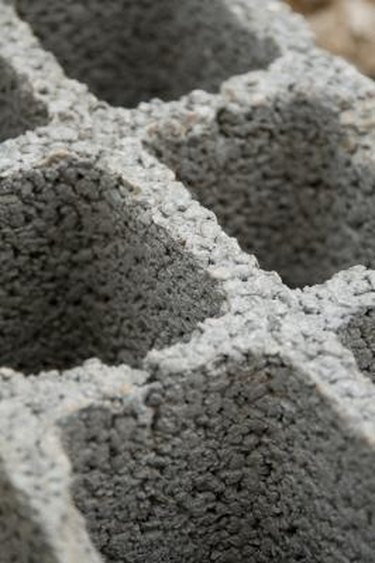
Cinder blocks, made from pouring concrete into a cast, are used as walls in buildings or as support units for other structures. While these blocks can handle both weight and weathering, the cinder block does have weaknesses. In fact, elements from the outside, and occasionally from within, can damage, crumble and destroy cinder blocks.
Bad Manufacturing
Video of the Day
Of course, a cinder block will crumble faster if it is poorly made. The materials used in the construction of cinder block concrete vary from conglomerate stone and lime to the ash that gives the cinder block its name. These materials are ground to a fine powder and mixed with water to create a strong bond. If the materials were not ground to a fine enough consistency or ground too fine, the concrete will set poorly and the cinder block could crumble on the outside or even have hollowing of the walls from within. Too little water added during the mixing or curing of the concrete can cause the concrete to expand in winter, breaking a cinder block apart from within.
Video of the Day
Water
Water is the primary cause for most crumbling concrete. This substance is known as the universal solvent since it is capable of breaking down almost any compound. Whether from flooding or from repeated rains, water eventually wears down the structure of a cinder block from the outside, causing it to flake off and crumble. If a block has not been properly cured, water can also infiltrate the interior of the block. Once the water is inside, it takes only one long freezing period to destroy a cinder block from within.
Impact
While cinder blocks are strong, they are not completely impervious to the threat of impact. Kicking and punching may do no good, but damage from a high-speed automobile impact or from a falling tree can be enough to reduce a cinder block to a crumbling mess.
Pressure
Cinder blocks are designed to handle a finite amount of pressure, but can buckle under a strain greater than the weight limit they were designed for. Builders can remedy this problem by spacing out the cinder blocks and distributing smaller amounts of weight among them. Cinder blocks must also be squarely placed, distributing the weight evenly around all parts of the block. Too much weight on one portion of the block will cause it to crumble.