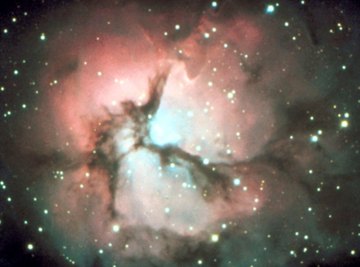
The stars of the Milky Way live to be about 10 million years old. The sun is one of these stars, but it has only lived about half of its lifespan. A student can design a project that hypothesizes what the age of the sun means for the future of Earth. But this is just one example of a project that explores the mysteries of the Milky Way galaxy.
Globular Clusters
A globular cluster is a grouping of a 10,000 to 1 million stars that orbits the galaxy. The Milky Way has hundreds of globular clusters that orbit close to the center and out on the edge of the galaxy. These clusters are some of the oldest components of the universe, aging up to 14 billion years. A scientist studies these clusters to learn about the history of the galaxy. A student can present these scientific inquiries in his project; using NASA's photos of the globular cluster components to illustrate the subjects of the studies.
Mapping the Milky Way
In 2010 the Rensselaer Polytechnic Institute began a massive project that recruited computers all over the world to map the Milky Way. A volunteer signs into a networking site called MilkyWay@Home and donates a portion of her PC's operating power to the Institute to make calculations that will map the entire Milky Way galaxy. A student can present this project at a science fair with an explanation of how the mapping works and why a scientist would want to map the Milky Way.
Mysteries
Although the Milky Way is Earth's home galaxy, it is still full of mysteries. Sagittarius A, for example, is a giant black hole located in the center of the Milky Way. Black holes are among the most mysterious occurrences in space. The strong gravitational pull of the hole makes it very difficult for scientific organizations to send equipment close enough to study its activity. A project presenting the questions surrounding black holes, and other Milky Way mysteries, is an intriguing topic that will engage classmates and teachers alike.
Other Projects
Project ideas involving the Milky Way are as numerous as the stars in it. A student can use her imagination to create her own project. For example, a project investigating how the Milky Way influenced the appearance of life on Earth, or a project that studies the age of stars humans see from Earth.
References
- Free Science Fair Project Ideas, Answers and Tools for Serious Students: The Milky Way and Beyond: Globular Clusters; Erica Davis, UCSC and Jean Brodie, UCO Lick; November 1, 2010
- NASA Goddard Space Flight Center: Ask an Astrophysicist; December 1, 2005
- Science Daily: Home Computers Around the World Unite to Map the Milky Way; February 11, 2010
- NASA: Milky Way’s Giant Black Hole Awoke from Slumber 300 Years Ago; Robert Naeye and Rob Gutro; April 15, 2008
About the Author
Tiffany Ross is a writer and actress who has been working in Chicago since 2004. She holds a Bachelor of Fine Arts in acting and is completing her Master of Science in Oriental medicine. Ross is a world traveler with experience working overseas.
Photo Credits
Ablestock.com/AbleStock.com/Getty Images