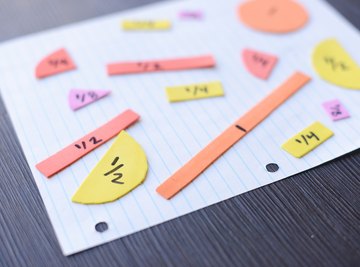

Fractions often challenge students, especially when they're first introduced. Manipulatives give students a concrete way to understand this unfamiliar, abstract mathematical concept. Regular practice with manipulatives -- from student-made paper items to objects you have at home or in the classroom -- gives students a hands-on approach to understanding fractions.
Classroom Manipulatives
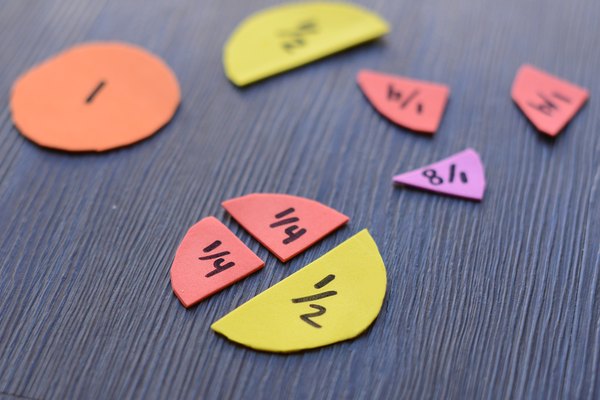
Math manipulatives designed specifically for fractions are a ready-made option. Fraction circles are an example. The circles are divided into different fractions, often with color coding to visually distinguish among the fractions. Commercially made fraction bars or fraction tiles are similar to fraction circles but have rectangular shapes. You can also use other objects you already have in the classroom, such as blocks. A set of blocks with different sizes works best. The largest block represents the whole. A block half that size represents one-half. Legos work well because of the multiple sizes that work down to one-eighth.
Student-Made Manipulatives
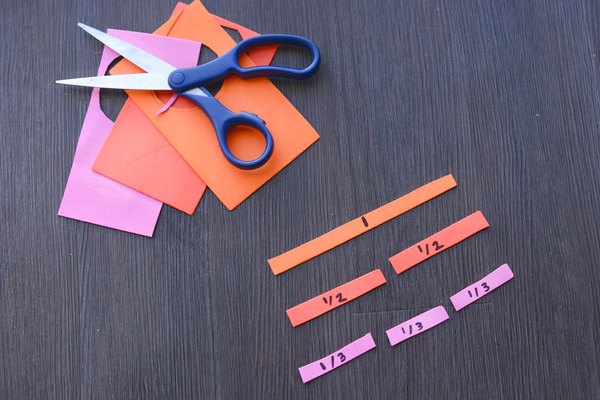
Students can make their own fraction bars using strips of paper. Students will use several strips of paper that are the same size. Each strip represents one whole. Students will divide each strip into parts representing different fractions. One strip remains whole as a reference to show the original size of the strips. Have students cut another strip in half. They should write the fraction 1/2 on each of the two pieces. This shows them what half of the whole strip looks like. They can place the two pieces next to the strip left whole to see that the two halves equal one whole. Repeat the process by cutting the next strip into three equal parts. Write 1/3 on each of the three sections. Continue to create other fractions as desired, such as cutting a strip into four equal sections for fourths or eight equal sections for eighths. You can use the same idea with other shapes, such as circles.
Counter Fractions
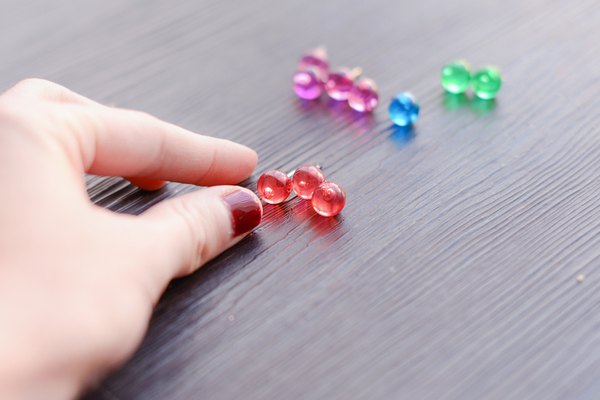
Another option is to use individual counters, such as beads, candies, marbles, cubes or plastic animals. You'll need counters that are the same size and shape but different colors. You might use red, green, orange and blue beads, for example. Instead of dividing one object into sections, like the fraction bars, the individual counters make up the total or whole. If you want to work on 10ths, each child needs 10 counters with at least two different colors. If three counters are red, students can say 3/10 of the total is red, for example.
Activities
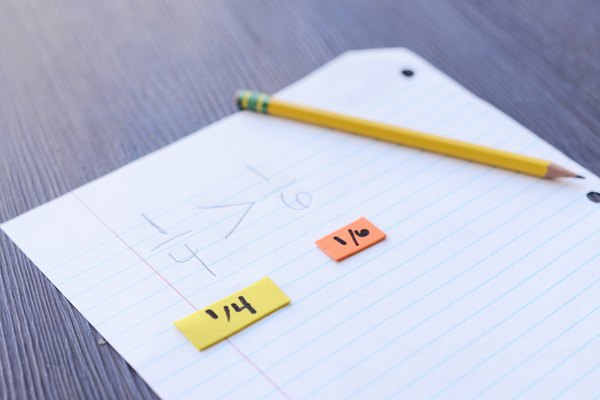
Use the manipulatives to first explore the idea of fractions. Students can see how the individual pieces fit together to make one whole. You can then use the manipulatives to compare different fractions. Using blocks, fraction bars or a similar manipulative, have students show a fraction, such as 2/3. Have them make an equivalent fraction, such as 4/6 or 8/12. When placed side by side, students see that the fractions are the same. Help students understand which fractions are larger by having them represent two different fractions, such as 1/6 and 1/4. Students might guess that 1/6 is larger because 6 is larger than 4, but the manipulatives show them that 1/4 is larger.
References
About the Author
Based in the Midwest, Shelley Frost has been writing parenting and education articles since 2007. Her experience comes from teaching, tutoring and managing educational after school programs. Frost worked in insurance and software testing before becoming a writer. She holds a Bachelor of Arts in elementary education with a reading endorsement.
Photo Credits
Alexa Smahl/Demand Media