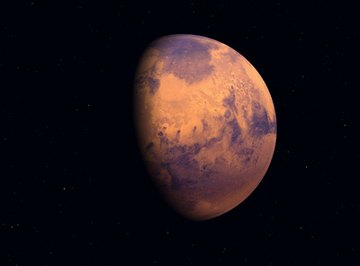

Mars is a fascinating planet, researched and examined by scientists for years. The combination of gases, bacteria and other substances discovered on the planet led researchers to believe that humans cannot inhabit Mars. That idea alone makes for a science project focusing on the planet. Mars science project ideas are suitable for children of all ages. Some ideas are even appropriate for younger children who are just beginning to learn about the solar system.
Life on Mars
Create a hypothesis determining whether life exists on Mars. Custom-fit the idea to your grade level and experience. Younger children may focus on the idea of whether humans can live on Mars, while older students may look at different types of living organisms. Include any research you find in the same vein, such as scientists who discovered bacteria living on Mars. Explain why certain types of organisms can live on the planet while others cannot. Use your research to back up the hypothesis you introduced at the beginning of the project.
Explain Mars
Make a science project that discusses the basics of Mars. Younger children may opt to create their own version of Mars by painting a large Styrofoam ball to resemble photographs taken of the planet. Modeling clay of different colors applied to a Styrofoam ball will also produce a fake planet that resembles the real one. Ask students to create a list of facts and data on Mars and have them present them along with their version of the planet.
Humans on Mars
Discuss in-depth the reasons why humans can’t survive on Mars, including the temperature and gases in the atmosphere. Then discuss what humans would need to do in order to adapt to life on Mars. Tell students to rely on science fiction ideas as a basis for their project and explain whether these ideas would work in real life. For example, discuss apparatuses that let humans breathe and survive on the planet. Or discuss what needs to happen on Mars for humans to live there and the odds of these changes occurring.
What You Need
Ask younger children to make a list of everything humans need to survive on Mars, including fresh air, drinking water and a food source. Older children who know more about Mars can write from the perspective of organisms living on the planet. The science project describes the atmosphere of Mars and how it allows certain types of organisms to live on the planet. The focus of the project is on what it takes to live on Mars and how these needs differ from those about earth.
References
About the Author
Jennifer Eblin has been a full-time freelance writer since 2006. Her work has appeared on several websites, including Tool Box Tales and Zonder. Eblin received a master's degree in historic preservation from the Savannah College of Art and Design.
Photo Credits
Mars Background image by Dan Collier from Fotolia.com