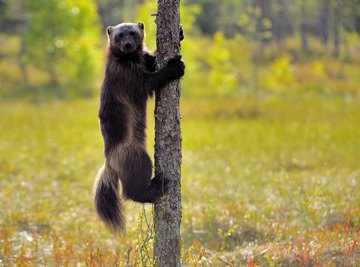

The wolverine animal, despite its name, is not a member of the wolf family. Even though it looks like a cross between a wolf and a bear, the nasty-smelling wolverine belongs to the weasel family. As a sexually dimorphic animal, with each sex of the species exhibiting different characteristics, male wolverines have an average weight of between 24 to 61 pounds, while females only weigh 15 to 24 pounds. Capable of eating frozen meat and crushing bones with their strong teeth, wolverines often spray their food with musk before burying it. This keeps away other carnivores and helps them to find their food cache when needed.
TL;DR (Too Long; Didn't Read)
As the largest member of the Mustelidae family, wolverines also scent mark their territories by spraying an offensive-smelling musk from anal scent glands, which is why scientific classification puts them in the same family as skunks.
Wolverine Classification and Taxonomy
Researchers classify every living organism from the smallest to the largest in a system that shows where they belong in the biological scheme. According to the Integrated Taxonomic Information System, which bases its classification system on the most up-to-date scientific consensus, the wolverine is categorized as follows:
- Domain: Eukarya
- Kingdom: Animalia
- Phylum: Chordata
- Class: Mammalia
- Order: Carnivora
- Family: Mustelidae
- Genus and species: Gulo gulo
- Subspecies: Gulo gulo, Gulo gulo katschemakensis, Gulo gulo luscus, Gulo gulo luteus and Gulo vancouverensis
Quick Facts About the Wolverine
- Nicknames include:
- little bear
- glutton
- stink bear
- skunk bear, quickhatch
- carcajou
- Often mistaken for small bears (hence the nickname), wolverines are the largest member of the mustelidae family that includes badgers, ferrets, sea otters, skunks and weasels. * Indigenous tribes and settlers in areas with deep winter snows made wolverine fur the trim of choice on parka hoods due to the fur's well-known frost-resistant qualities. * North American Indian tribe mythology viewed the wolverine as a trickster with a special link to the spirit world who often appeared in oral stories and folktales as a shrewd and fierce beast with extraordinary strength. * Wolverines can smell hibernating prey buried beneath 20 feet of snow. * The feet of the wolverine, who live primarily in regions with deep snow, act like snowshoes by spreading wide and flat across the snow's surface, helping them better navigate wintery terrain. * The territories of male wolverines range in size from 40 to 372 square miles. * Wolverines hide their kills in the snow to keep them fresh for later eating. * Wolverines often eat the teeth and bones of their prey. * Wolverines once lived in the Great Lakes region – Michigan, Minnesota and Wisconsin – until trappers, who considered them pests, killed them off.
Wolverines Are a Circumpolar Species
As a circumpolar species – living in areas that abut the globe's arctic polar regions – the wolverine animal prefers boreal forests and tundra ecological communities dotted with a variety of pines, firs, spruce, aspen trees, hemlock, lodgepole pine and more that receive plenty of snow in the winter in areas of North America, Europe, Asia and Russia. Though most of the U.S. populations are gone, wolverines do still live in the Rocky Mountain region with small populations in the high mountains of the Pacific Coast states of Washington, Oregon and California, such as the Cascade and Sierra Nevada mountain ranges.
Wolverines on the North American Continent
The largest wolverine populations in North America occur in northern Canada and Alaska. But there is a healthy and stable population of wolverines in the mountains of Montana with population density estimates at one animal per 40 square miles. In Alaska, northern British Columbia and Canada's Northwest Territories, the animals have larger territories with density figures at one wolverine per every 124 square miles. The International Union for Conservation of Nature and Natural Resources estimates the total British Columbia wolverine population at about 3,530 wolverines.
Short, Powerful Limbs and Strong Bodies
The short and powerful limbs of the wolverine make them excellent climbers and hunters. The wolverine often moves across the snow with its toes and metatarsals, which the University of Michigan's Animal Diversity Web calls "a semi-plantigrade form of locomotion. " This places most of the wolverine's body weight on the metatarsals, a select group of bones found between the phalanges and the hind area of the foot. This method of movement helps them better distribute their weight, especially when moving and hunting in snow. This helps them catch larger prey stuck or trapped in deep snow.
Though wolverines are the largest member from the weasel family, wolverines have bodies that are only 25 to 41 inches long with tails 5 to 10 inches long trailing behind them. Females generally run smaller than males by 10 percent in length. Tipped by five powerful and semi-retractable claws on their toes, their feet often look too big for their bodies because the feet flatten across the snow.
The Wolverine Animal Has Straw-Colored Stripes
The fur that covers wolverines tends to be brown or a mixture of brown and black, with a long gold or yellow stripe that runs from above the eyes of the animal, across the crown of the creature's head, side to side across each shoulder and down its back all the way to its rump. The stripes join at the junction of the tail.
With a stocky appearance, a strong body and a large head marked by small rounded ears, the wolverine's limbs are short, but powerful. Wolverines are shy, loner creatures, not often spotted in the wild because of their large territories and small populations. Because of the wolverine's fur, which has a thick, almost impenetrable oily coat that sheds water easily, it can live in exposed shelters during harsh conditions. The animal's fur characteristics made wolverine pelts highly prized among native peoples, trappers and pioneers of earlier centuries, as human breath, when frozen on the fur, easily brushes off.
The Wolverine's Scientific Name Means "Glutton"
The scientific name Gulo gulo comes from Latin, which essentially translates to "glutton," one of the nicknames used for wolverines. As omnivores, wolverines prey on a variety of animals and often scavenge the kills of other creatures, even to the point of taking on grizzly bears over food. They typically don't stalk or chase prey, but lie in wait to ambush their kills. Sometimes they climb into trees for a better vantage point when hunting or to find egg-bearing nests.
Because of their strength, wolverines can take down prey up to five times larger than themselves, but typically do this with prey like reindeer trapped in snow. Large prey includes roe deer, elk, wild sheep, moose, reindeer, red deer and maral. Though wolverines usually have a lumbering gait, they can chase prey at speeds of up to 29 miles per hour when they need to.
Wolverines Are Opportunistic Eaters
As opportunistic eaters, wolverine diets change with their locations and seasons. As aggressive creatures strong for their size, wolverines also scavenge seal, walrus and whale carcasses. When they go after cloven-hoof animals, they typically kill them by first biting the back or front of the neck, chomping through neck tendons or compressing the ungulate's trachea.
Females rearing their young typically hunt more often, seeking out small-to-medium animals like ground squirrels, hares, rabbits, lemmings and marmots. The amount of food in regions where females raise their young often plays a part in the reproduction success of the species. Because they are opportunistic hunters and gluttons, wolverines often kill more prey than they can eat or store in a food cache.
Wolverine Predators – When Caught Unawares
Adult wolverines generally don't have any prey, as animals that do prey on them, do so very carefully because of how aggressive and strong the wolverines are. Wolverines are known to take on bears, wolf packs and even mountain lions when threatened or when scavenging food. The wolverine's main predators are wolves when caught out in the open (as they usually escape by climbing a tree), but most predators go after the young wolverines who are not as strong as the adults. Predators of inexperienced wolverines include:
- Black bears
- Brown bears
- Eagles
- Mountain lions
- Wolves
Wolverine Mating Habits
As primarily solitary creatures, male and female wolverines usually only come together during the mating season, which occurs from May to August, with females in heat from June to August. Males hang around females during the mating season but live alone for the rest of the year. As polygynous creatures, females may mate with several males, but they usually bear only the litter from one male. Both male and female wolverines reach sexual maturity at about two to three years old, with females giving birth every other year.
Female Wolverines Are Sexual Instigators
Females initiate sex, and most researchers believe that the act of copulation begins the ovulation process in the female, which is like other mustelidaes. Once ovulation occurs, the fertilized eggs or embryos undergo a period of suspension in the female body for about six months before they implant in the womb, which is why they bear offspring every other year. After the embryos implant, wolverines stay pregnant for about 50 to 60 days more, for a total gestation that lasts anywhere from 120 to 272 depending on when the eggs become fertilized and the length of time before implantation.
Litter births generally occur between January and April in a snow den built by the female with an average of one to three kits born. Kits weigh less than 1/4 pound at birth. The female nurses her young for three months before she weans them. Mothers feed their young from their hidden food caches buried in the snow after weaning and until kits reach five to seven months of age when they begin scavenging on their own. Kits become adults at about a year old.
Wolverines Live About Five to Seven Years in the Wild
On average wolverines live from five to seven years old, but they can live up to 13 years old in the wild. Wolverines in captivity have lived up to 17 years of age in captivity, with some females breeding until the age of 10. While most predators stay away from adult wolverines, the wolverines can become prey to wolves and mountain lions as they age. The main causes of death in the wolverine include starvation, predation and trapping.
A Species of "Least Concern" on IUCN Red List
The IUCN maintains a list of threatened and endangered species around the world. At various periods from 1988 to 1996, IUCN listed the species as vulnerable, changing its status in 2008 to near threatened, which changed in 2009 to a species of least concern meaning it is not on the endangered species list, but it is a threatened species due to loss of food from humans hunting ungulates and human encroachment on its territories.
In Russia, hunters and trappers regularly go after wolverines as a game species, which has decimated many of the populations there. In the U.S., only hunters in Montana and Alaska can legally hunt the wolverine, and some Scandinavian countries control the number of wolverines living near reindeer populations. In most of the countries where wolverines live, conservationists strive to educate people about wolverines, protect wolverine habitats and try to eliminate unregulated hunting. Climate change is also having an impact on the species, as less snow makes it harder for the wolverine to hunt its prey on snowless ground, which also makes the animal more susceptible to predators.
References
- International Union for Conservation of Nature and Natural Resources Red List: Gulo Gulo
- Grove City College: Wolverines... Who Knew?
- U.S. Forest Service: Fire Effects Information System: Gulo Gulo
- University of Michigan Animal Diversity Web: Gulo Gulo Wolverine
- One Kind Planet: Wolverines
- Yale Environment 360: Warming Signs: How Diminished Snow Cover Puts Species in Peril
About the Author
As a journalist and editor for several years, Laurie Brenner has covered many topics in her writings, but science is one of her first loves. Her stint as Manager of the California State Mining and Mineral Museum in California's gold country served to deepen her interest in science which she now fulfills by writing for online science websites. Brenner is also a published sci-fi author. She graduated from San Diego's Coleman College in 1972.