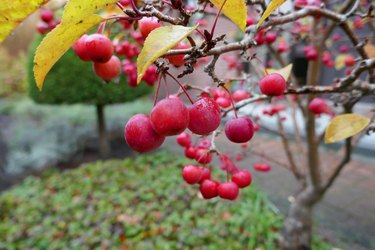
Crab apples are closely related to regular apples, and both produce flowers in springtime as well as edible fruit. While crab apple flowers can be extremely ornamental, the fruit tends to be smaller and less scrumptious than those of regular apple trees. Though the sourness of the fruit may taste awful, they have been eaten for centuries.
Meet the Crab Apple Tree
Video of the Day
The crab apple tree (Malus sylvestris) is not just in the same genus as the apple tree; it is one of the wild ancestors of commercial apples. Like commercial apple varieties, crab apple trees can vary widely in appearance. All tend to be short with a spreading canopy of an irregular, rounded shape. Crab apples generally have gray bark and twisted or gnarled branches, and it is not unusual for the branchlets to develop spines. This gives them a similarity to a crab's shape and may be the reason for their common name "crab apple."
Video of the Day
Despite their "crabby" appearance, crab apples can be extremely ornamental, with lush blossoms in springtime in lacy white or shades of pink or red. Some varieties offer a different show in the fall as leaves turn fiery shades, though not every crab apple tree provides a fall display. Most crab apple trees also produce crab apples.
Learn About Crab Apple Fruit
Crab apples resemble commercial apples, but they are usually much smaller. In the wild, they tend to be yellow-green in color, but some are red when they ripen. All crab apple fruit are less than 2 inches in diameter.
Anyone taking a large bite of the small crab apple will quickly discover their mistake. All fruit of a crab apple tree lacks the sweetness of a regular apple and will taste sour or bitter. Some crab apples are not palatable without first cooking and sweetening the fruit. The fruit makes an excellent jelly and has been roasted for centuries in Europe to eat with meat.
Understand Crab Apple Toxicity
Crab apple trees present no danger to adults or children in terms of toxicity. The leaves and bark are not toxic, and the twigs, flowers, and fruit will not poison a human or animal. In fact, crab apple tree foliage, flowers, and fruit are often consumed by wildlife and even domestic animals.
While the flesh of the crab apple fruit is completely edible, it is probably not a good idea to eat an extensive amount of the fruit seeds since they contain a sugar and cyanide compound called amygdalin that can make up less than 1 percent of a seed's chemical content. This amygdalin would only produce adverse effects if many seeds were consumed and if they were crunched up when eaten. This is not limited to crab apple seeds but is also true of regular apple seeds as well as those of almonds, apricots, peaches, and cherries.