
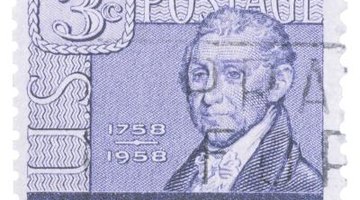


The Era of Good Feelings was a period of American history that coincided with the presidency of James Monroe, from 1816-1824. The term was coined by journalist Benjamin Russell, and referred to the lack of partisan division in American politics following the collapse of the Federalist Party after the War of 1812. Despite the name, however, the Monroe presidency was not without its divisiveness, particularly on issues of economics and slavery, and the seeds of future partisan divisions can be found in this era.
Background
Before 1816, the country was divided between the Federalists and the Democratic-Republicans. The Federalists became nationally disgraced after the Hartford Convention of 1814-1815, in which Federalists opposed to the War of 1812 tried to have New England secede from the country. After the U.S. won major victories during the war, however, this secession seemed like treason, and the Federalists Party quickly collapsed. The Democratic-Republicans became the only viable political party, James Monroe won the 1816 election with 80 percent of the vote and the Era of Good Feelings began.
Panic of 1819
Yet Monroe's presidency faced a significant challenge with the Panic of 1819. Though the Democratic-Republicans had been opposed to the Federalist economic policies envisioned by Alexander Hamilton, over time many Democratic-Republicans, including Monroe, had come to accept many of these principles, including the need for a national bank, which was re-established in 1817. When the Panic occurred, many blamed the national bank, and the Democratic-Republicans became divided between the New Republicans, who had supported the Federalist economic system, and the Old Republicans, who hadn't.
Missouri Crisis
Another crisis faced by the Monroe Presidency was over the issue of slavery in Missouri, which sought statehood in 1819. Because the number of free states and slave states were equal, Congress could not agree on whether to prohibit or allow slavery in Missouri, as it would disrupt the balance in the Senate. The issue was solved with the Missouri Compromise of 1820, which admitted Missouri as a slave state and Maine as a free state. The debate over slavery in Missouri revealed yet another significant issue debated during the supposed Era of Good Feelings that would divide the country in the future.
Good Feelings End
The Era of Good Feelings ended with the election of 1824. Andrew Jackson, a member of the Old Republican faction who opposed the Federalist economic policies, ran against John Quincy Adams, Monroe's Secretary of State and one of the New Republicans. Jackson received the most votes but failed to achieve a majority, and the election went to Congress. Adams and Speaker of the House Henry Clay, another supporter of Federalist economic policies, made what Jackson called a "corrupt bargain," whereby the House would make Adams president in exchange for Clay being appointed secretary of state. Jackson went on to found the Democratic Party and Clay founded the Whig Party, ending the short-lived Era of Good Feelings.
Related Articles






References
- "Don't Know Much About History"; Kenneth C. Davis
- "The Economy of Early America: Historical Perspectives and New Directions: The Panic of 1819 and the Political Economy of Sectionalism"; Daniel S. Dupre
- "American Political Parties and Elections: A Very Short Introduction"; Jr. L. Sandy Maisel and William R. Kenan
- "A Companion to James Madison and James Monroe": President James Madison's Domestic Policies, 1809-1817: Jeffersonian Factionalism and the Beginnings of American Nationalism; Aaron N. Coleman
Writer Bio
Aatif Rashid writes on international politics and culture. His articles have appeared in magazines such as "The Oxonian Globalist" and online at Future Foreign Policy and ThinkPolitic. He holds Bachelor's degrees in English and history from U.C. Berkeley and a Masters degree from the University of Oxford.