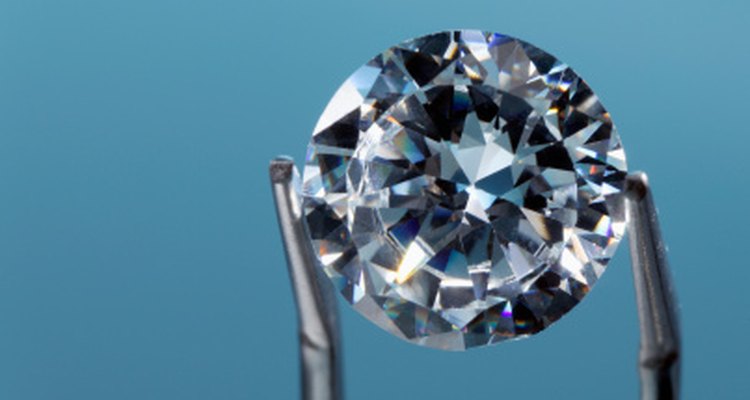
Diamonds may be a girl’s best friend, but that girl often needs a fat wallet to afford them. Their rarity and consequent high cost are two reasons for the popularity of numerous diamond substitutes. These look-alikes include the commonly known cubic zirconia, as well as lesser-known simulations, such as strontium titanate. This less common “fake diamond” looks a bit like the real thing, though it is really quite different.
Formation
One of the biggest differences between these two substances, is of course, that diamonds are a naturally occurring substance, while strontium titanate is manmade. Real diamonds are formed when carbon is exposed to extreme pressure and heat, and the purest of the gemstones are made of that element only. Strontium titanate is composed of the elements strontium, titanium and oxygen and is not found in nature.
Hardness
On the Mohs scale of gem hardness, genuine diamonds rank right at the top, with a hardness of 10, making them extremely scratch-resistant. Strontium titanate, on the other hand, has a hardness of just 5, making it relatively soft in comparison. This is about the same hardness as gems like turquoise and lapis lazuli, and a common knife blade earns close to the same ranking.
Brilliance
This may be the one area in which strontium titanate beats a genuine diamond. Both are single-refraction gems, meaning that lights bends through them in only one direction. This makes for a high dispersion, the property of a stone that lets it split light into the colors of the spectrum. Diamonds have a very high dispersion of 0.044, but strontium titanate has an even higher one, 0.109, making it sparkle even more.
Color
When it comes to hue, strontium titanate may be about as close to a real, pure diamond as simulated stones get. Very pure diamonds are colorless, or nearly so, and strontium titanate is the same. Occasionally, this simulated diamond may exude a slight yellowish tinge, but it is never found in the array of colors in which less pure diamonds can occur, such as pink or blue.
Related Articles

Tanzanite Vs. Diamonds
The Value of Commercial Grade Diamonds
Types of Valuable Crystals
What Is the Luster of a Diamond?

What Is Cognac Amber?
Cubic Zirconia Vs. White Spinel
Physical Characteristics of the Ruby ...
Which Types of Gems Are Most Expensive?
How to Tell If a Gem Is a Kunzite?
What Is 916 in Jewelry?

How Valuable Is a Garnet in Carats?
What Is the Difference in K and KT in ...
Nutrition in Carob Vs. Chocolate
What Is Ceylon Sapphire?
List of the Types of Semi-Precious ...
What Is the Range of the Cost of Pearls?
What Is 18 Carat Gold?
How to Tell If a Blue Diamond Is Real?
What Is Golden Druzy?

Difference Between Manmade & Natural ...
References
Writer Bio
Based outside Pittsburgh, Jamie Rankin began her career as a professional writer as a news and sports journalist with the "Daily Courier," a subsidiary of the "Pittsburgh Tribune-Review." Her work has appeared in both publications. Rankin, who holds a Bachelor of Arts degree in journalism and communications from Point Park University, has been writing sports and pet-related articles online since 2004.
Photo Credits
Jeffrey Hamilton/Digital Vision/Getty Images