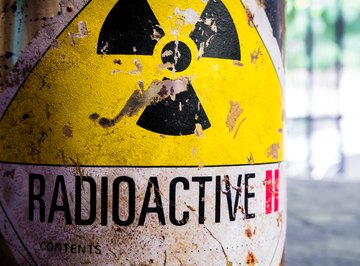
Of the three main types of radiation given off during radioactive decay, two are particles and one is energy; scientists call them alpha, beta and gamma after the first three letters of the Greek alphabet. Alpha and beta particles consist of matter, and gamma rays are bursts of energy. The type of radiation emitted depends on the radioactive substance; cesium-137, for example, produces beta and gamma radiation but not alpha particles.
What Happens During Radioactive Decay?
An atom that gives off radiation has an unstable nucleus; in many cases this means it has too many neutrons. Atoms relieve the instability by splitting into pieces or emitting radiation; because this may change the number of protons in the nucleus, it might become a different element. For example, uranium-238 emits an alpha particle and becomes thorium-234. The “daughter” atom may also be radioactive; each new element becomes a step in a process that ends with a stable atom.
Alpha Particles
Alpha particles are two protons bound to two neutrons -- essentially, it is the nucleus of a helium atom. Compared to other forms of radiation, alphas are heavy and have little power to penetrate matter; a few feet of air or a single sheet of paper is all it takes to block them. However, if radioactive material is ingested, alpha radiation can wreak havoc inside the human body, as it becomes embedded in the lungs and other vital organs. Inside the Earth, alpha particles given off by radioactive minerals become pockets of helium gas. Elements that emit alpha radiation include uranium and polonium.
Beta Particles
As with alpha particles, beta radiation comes from the nucleus of an unstable atom. Betas are electrons, and their mass is much smaller than that of alpha particles -- about 1/8,000th as much. Their penetrating power is somewhat stronger than alphas, requiring a few millimeters of plastic or other light material to block them. Like alpha radiation, beta particles are electrically charged; betas have a charge of -1, and alphas have a +2 charge due to their having two protons. Radioactive cesium-137 and strontium-90 are examples of beta emitters.
Gamma Rays
Gamma rays are a form of electromagnetic radiation, as are visible light, radio waves, infrared and X-rays. Unlike alpha and beta particles, gamma rays have no mass and no electric charge. When an unstable atom gives off gamma radiation, the element remains the same. For example, radioactive barium is still barium after producing gamma rays. Protecting against gammas requires lead or concrete shielding, as the radiation is extremely energetic -- they are akin to X-rays but with even more penetrating power. Gamma-ray producers include cesium-137, cobalt-60 and plutonium.
References
About the Author
Chicago native John Papiewski has a physics degree and has been writing since 1991. He has contributed to "Foresight Update," a nanotechnology newsletter from the Foresight Institute. He also contributed to the book, "Nanotechnology: Molecular Speculations on Global Abundance." Please, no workplace calls/emails!