
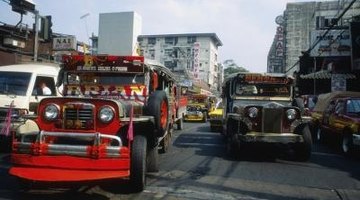


Tagalog is a language that is widely used throughout the Philippines. It is spoken by approximately 21 million people in the country as a first language, and as a second language by the entire 76.5 million population (as of 2011). The structure of Tagalog is similar to English and has many of the same parts of speech.
Nouns and Pronouns
A noun is a word used for a person, place, thing, animal, event or abstract idea. A pronoun is a word that replaces a noun. The Tagalog term for "noun" is "pangngalan" and "pronoun" is "panghalip." Examples of singular nouns in Tagalog are "bahay" ["house"], "paaralan" ["school"], "kagubatan" ["forest"], "ilog ["river"], "digmaan" ["war"], "pag-ibig" ["love"], "sundalo" ["soldier"], "mandirigma"["warrior"], "babae" ["girl"] and "lalaki" ["boy"]. These nouns can become plural by adding the word "mga" before the word. For instance, the plural form for "bahay" ["house"] is "mga bahay" ["houses"], and "mga mandirigma" ["warriors"] for the singular noun "mandirigma" ["warrior"]. Tagalog pronouns include "siya" ["he/she"], "ako"["I"], "sila"["they"], "ikaw"["you"], "tayo"["we"] and "ating"["our"].
Adjectives and Adverbs
An adjective is a word that modifies or describes a noun in the sentence. An adverb is word that describes a verb, adjective or another adverb. The word "adjective" is "pang-uri" in Tagalog while "adverb" is "pang-abay." Some of the adjectives in Tagalog include "maganda" ["beautiful"], "masaya"["happy"], "mura"["cheap"], "matapang"["brave/courageous"], "malaki"["big"], "mabait"["kind"], "magalang"["courteous"] and "matalino"["intelligent"]. Tagalog adjectives can be used for comparison as well. The word "mas" is added before the adjective to show comparison between two person or objects, while the word "pinaka" is added as a prefix to the word to show comparison among three or more objects. For instance, the comparative terms for "malaki"["big"] are "mas malaki"["bigger"], and "pinakamalaki"["biggest"]. Tagalog adverbs can also be classified as adverbs of manner, time, frequency and place. Examples of adverbs of time are "ngayon"["now"], "kahapon"["yesterday"], and "bukas"["tomorrow"]. Adverbs of manner includes "dahan-dahan"["slowly"], "mabilis"["quickly"] and "mabuti"["carefully"]. Adverbs of place include "dito"["here"], "doon"["there"], "sa lahat ng dako"["everywhere"] and "kahit saan"["anywhere"]. Adverbs of frequency include "lagi"["always"], "madalas"["frequently"] and "kung minsan"["sometimes"].
Verbs
Verbs are action words. In Tagalog, "verb" is "pandiwa." Examples of root verbs in Tagalog are "lakad" ["walk"], "maneho" ["drive"], "laba" ["wash"], "laban" ["fight"] and "linis"["clean"]. These root verbs can be transposed also to be in their past, present and future forms. Usually, the word "nag" is prefixed on the word to form its past tense. For example, the past tense of the root verb "lakad" ["walk"] is "naglakad"["walked"], "nagmaneho" ["drove"] for "maneho"["drive"], "naglaban" ["fought"] for "laban" ["fight"], and "naglinis" ["cleaned"] for "linis" ["clean"]. To form their present progressive form, the word "nag" plus a repetition of their first syllable is prefixed on the word. For instance, "lakad" ["walk"] to "naglalakad" ["walking"], "maneho" ["drive"] to "nagmamaneho" and "laban" ["fight"] to "naglalaban" ["fighting"]. The future tense of the root verbs is formed by prefixing the word "mag" plus a repetition of the verb's first syllable. This results in "maglalakad" ["will walk"], "maglalaba"["will wash"], "maglalaban" ["will fight"] and "maglilinis"["will clean"].
Prepositions and Conjunctions
A preposition is a word that links nouns, pronouns or phrases to other words in the sentence. Conjunctions are used to join words or clauses together. "Preposition" in Tagalog is "pang-ukol," and "conjunction" is "pangatnig." Examples of Tagalog prepositions include "alinsunod kay" ["in accordance with"], "ukol sa" ["about"], "ayon kay" ["according to"], and "hinggil sa" ["about, regarding, with regard to"]. Tagalog conjunctions include "at" ["and"], "o" ["or"], "ni hindi" ["nor"], "kaya" ["so"], "gayon pa man" "yet"] and "kung" ["whether"].
Markers
Markers are grammatical elements that are used to show definiteness. They serve the same functions as the article in English. Markers are usually used before the noun. Examples of Tagalog markers include "ang" ["the"], "sa" ["in/on"], "ng"["of"] and "ito" ["this"].
Related Articles






References
Writer Bio
Palmer Owyoung holds a Master of Arts in international business from the University of California at San Diego and a Bachelor of Arts in sociology from the University of California at Santa Barbara and is a trained molecular biologist. He has been a freelance writer since 2006. In addition to writing, he is a full-time Forex trader and Internet marketer.