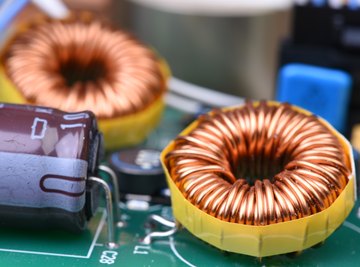

Magnets come in two main types: permanent magnets and electromagnets. As its name suggests, a permanent magnet is always magnetized -- think of a kitchen magnet that stays stuck to a refrigerator door for years. An electromagnet is different; its magnetism works only when powered by electricity. Although an electromagnet is more complicated than a permanent magnet, it has useful and important advantages.
Control of Magnet Strength
One of the most important features of an electromagnet is the ability to change its magnetic force. When no electric current flows through the magnet’s wires, it has no magnetic force. Put a little current in the magnet, and it has a small force. A large current gives the magnet a bigger force, able to lift or pull heavier objects. The ability to turn magnetic force on and off has many important uses, ranging from simple household gadgets to giant industrial machines.
Greater Magnet Power
The pulling power of a permanent magnet is limited to the type of metal from which it’s made. Currently, the strongest permanent magnets are made of a combination of iron and a metal called neodymium. Although these permanent magnets are strong, the best electromagnets are more than 20 times stronger.
Electromagnet Uses
Small electromagnets are used in electronic locks, such as those found on an automobile or the main door of an apartment building. Scrapyard cranes have powerful electromagnets that lift metal car bodies with ease. Magnetic Resonance Imaging machines use very powerful electromagnets to produce highly detailed images of the human body. The strongest electromagnets are those used in scientific research to study the properties of matter.
Permanent Magnet Uses
You can find small permanent magnets in toys, handheld gadgets such as electric razors, and clasps for bracelets and watches. Larger permanent magnets are useful in household appliance motors and in stereo speakers. The electric motors in hybrid vehicles use very strong permanent magnets.
About the Author
Chicago native John Papiewski has a physics degree and has been writing since 1991. He has contributed to "Foresight Update," a nanotechnology newsletter from the Foresight Institute. He also contributed to the book, "Nanotechnology: Molecular Speculations on Global Abundance." Please, no workplace calls/emails!