
How to Make Your Own Plexiglass Backboard
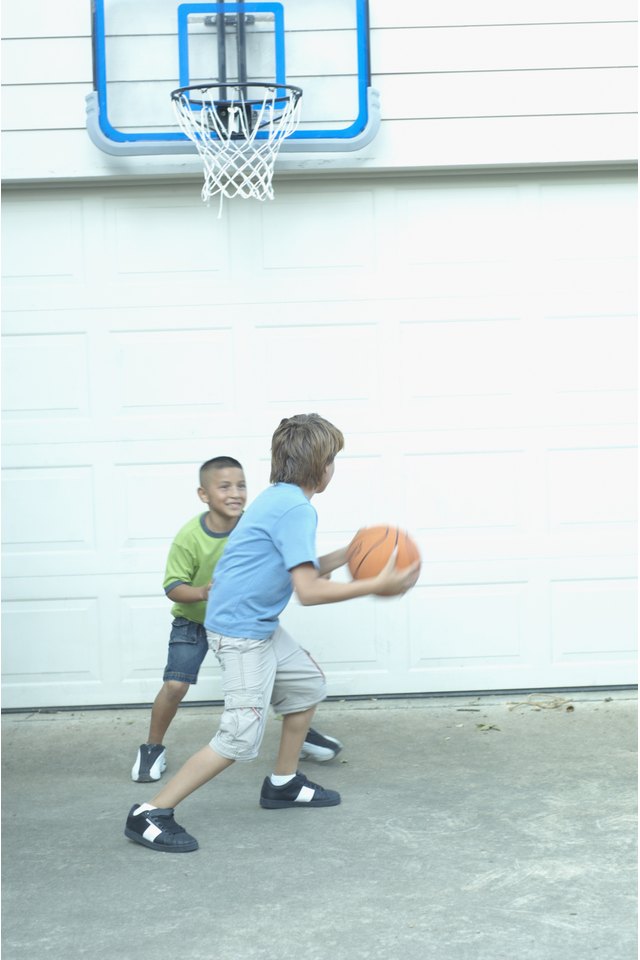
Plexiglass is a weather resistant alternative to traditional plywood basketball backboards. A see-through backboard for the hoop is both practical and attractive. An added bonus for players is the big arena appearance for neighborhood games. A regulation size backboard can be inexpensive to make, but does require the right tools and patience.
Cutting the Plexiglass
Measure and mark cutting lines. A regulation size backboard measures 1,800 mm wide by 1,050 mm high, which translates to 70.86 inches by 41.43 inches. Mark the measurement points with a pencil. Draw a straight line between parks using a straightedge. Ensure the penciled guidelines are square to the manufactured edges of the plexiglass with the T-square.
Double check all measurements. Confirm that each line is square to its respective edge. If a rounded top, or shaped corners are preferred, draw those cutting lines at this time.
Saw along the cutting lines. Use safety precautions when cutting. Wear safety glasses and dust mask, as the process creates airborne particles and fumes that can irritate the eyes, lungs and mucus membranes. Work in a ventilated area while wearing safety glasses and a dust mask. Obtain assistance for handling the large sheet and applying saw blade coolant while cutting. The coolant to prevent scorching the plexiglass, for smoother blade movement and reducing dust.
Router the cut edges. Position the plexiglass between the fluted edges of the router bit and pass the router along all edges while wearing safety glasses and dust mask. This process creates a smooth, safe and attractive edge.
Boundary and Borders
Define the position of the rectangle behind the hoop. Locate the vertical center of the backboard. Based on the width measurements in Section 1, the vertical center should be 900 mm or 35.43 inches inward from either edge. From this center point, along the bottom of the backboard, measure and mark 295 mm or 11.61 inches to the left, and again to the right of the vertical center. These two marks designate the location for the outside of the vertical borders. Use the T-square to draw vertical guidelines about 20 inches high.
Mark the vertical center of the front plate of the mounting bracket that holds the hoop. Line-up the center of the front plate with the center of the backboard. Keeping the bottom of the front plate flush to the bottom of the backboard, draw a line on the plexiglass using the top of the front plate as a guide. This new line is the location for the hoop, and defines the top of the lower horizontal border of the rectangle. Use the straightedge to extend the line to the vertical guide lines. The pencil guidelines should look like a “U” with a square base.
Apply tape along the bottom of the rectangle. Standing at the vertical center of the backboard, apply tape from the left vertical guide to the right vertical guide, it's okay to overshoot the guidelines, the tape will be neatly trimmed later. Be particular that the top horizontal edge of the tape is lined-up to the horizontal guideline.
Locate the top horizontal line of the rectangle. Measure upward, from the bottom border of the tape application, along each vertical guideline your choice of 450 mm or 17.72 inches. After marking the points on each line, draw a straight horizontal guideline between the points. Apply tape along the top horizontal guideline with the top edge of the tape on the pencil line. Do the same with the two vertical guides, with the outermost edge of the tape on the pencil lines. Use the straightedge as a cutting guide to trim the corners of the rectangle with the razor cutter. Apply tape along the edges of the backboard to define the border, framing the plexiglass. When finished, attach the front plate and pre-drill holes in preparation for mounting on to the backstop.
Tips
Ridout Plastics, a plexiglass manufacturer, recommends protecting the new backboard from the elements and help the plastic retain its luster with a quality automobile paste wax. Apply a thin, even coat of wax with a soft flannel or jersey cloth. Buff lightly. After polishing, wipe with a clean damp cloth to ground any electro-static charges which may attract dust particles.
References
- International Basketball Federation; "Official Basketball Rules 2010 Basketball Equipment; FIBA"; April 2010
- Ridout Plastics: Plexiglass Sheets – Plexiglass Acrylic Sheets
- Arkema”; "Acrylic Sheet Fabrication Manual"; Altuglas International; 2006
- Ridout Plastics: Cutting Plexiglass – How to Cut and Fabricate Plexiglas Sheet
Tips
- Ridout Plastics, a plexiglass manufacturer, recommends protecting the new backboard from the elements and help the plastic retain its luster with a quality automobile paste wax. Apply a thin, even coat of wax with a soft flannel or jersey cloth. Buff lightly. After polishing, wipe with a clean damp cloth to ground any electro-static charges which may attract dust particles.
Writer Bio
Cynthia Clark began writing professionally in 2004. Her work experience includes all areas of small-business development, real-estate investments, home remodeling and Web development. Clark is skilled in a number of design disciplines from digital graphics to interior design. Her diverse background and commonsense problem-solving skills allow her to tackle a variety of topics as an online writer.