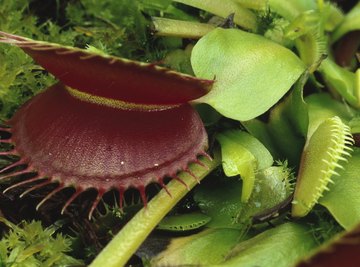

Most plants receive their nutrients through a combination of water and minerals in the soil and sunlight, but some plants use a much different method to sustain themselves. The Venus Flytrap is one such plant. It is unique in that it is carnivorous, consuming small insects to live. Because of these plants' unique properties, they are ideal for science projects.
Sunlight's Effect on Trap Speed
The "mouth" of the Venus Flytrap automatically closes when a foreign object places pressure on the inside of the leaf and touches the sensitive "hairs" on the outside of the leaf. One experiment you can conduct is whether sunlight has an effect on the speed at which the plant's leaves close. You will need to expose several Venus Flytraps to varying degrees of sunlight, ranging from extraordinarily faint light to completely unfiltered sunlight. Use the tip of a pen or another small object to tap the inside of the plant's leaves and time how long it takes to close. Write down your results and see if the amount of light has any effect on the speed of the plant.
Carnivorous Plant Behavior
This project, meant to facilitate an understanding of carnivorous plant behavior, is age-appropriate for second-graders, according to the website Science Project Lab. The project only requires one Venus Flytrap, a poking device and adult supervision. Carefully touch various parts of the plant to see whether or not it causes a reaction in the trap's leaves. Touch the inside of the plant's "mouth" without touching the green feelers on the outside of the leaves. Now touch only one green feeler. Continue touching various places on the plant to see what triggers a reaction.
What Foods Promote Growth
A popular Venus Flytrap experiment involves feeding the plant various food substances and monitoring which food substances positively and negatively influence growth. The project requires several Venus Flytrap plants. Each plant is fed a different substance. One might only receive flies. Another might only receive small amounts of hamburger meat. Record qualitative information, such as how the plant looks every day, as well as quantitative information, such as how tall the plant is.
References
About the Author
For three years, Etch Tabor worked as the technology and online editor at "InsideCounsel" magazine, a national publication for in-house counsel. He currently is a full-time freelance writer, specializing in legal, technology and comedy writing. He graduated in 2004 from the University of Missouri-Columbia with a degree in journalism.
Photo Credits
Hemera Technologies/Photos.com/Getty Images