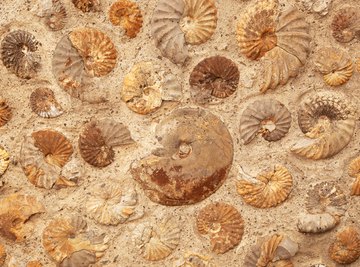
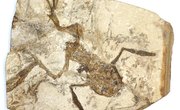
Fossils are the foundation for scientists’ understanding of the history of Earth and all life on it. Everything humans know about dinosaurs, earlier species of hominids, and all other extinct species began with the discovery of fossils. Much of what anthropologists now understand about early human migration comes from fossils. Scientists’ knowledge of mass extinctions and their ability to make predictions about the planet’s future are largely based on fossils. While the prevailing image of fossils is a paleontologist painstakingly digging up a massive dinosaur skeleton in a remote desert, there are several different types of fossils, and together they form a clear picture about life on Earth before modern humans came to be.
Petrified Fossils
Petrification, which is also known as permineralization, is the process by which the cells of highly porous organic materials such as bones, nuts and wood are gradually replaced over time with minerals. This process happens in situations such as volcanic eruptions. When a tree or animal is buried so suddenly that it does not have a chance to rot or be eaten by a predator, the ash and heat over time transform the organism to stone, preserving it for millennia. Petrified fossils are the ones that most people tend to think of as fossils because they are large and hard and mostly consist of the bones found in archaeological digs. Petrified fossils are the most common fossils and have given paleontologists a great deal of information about prehistoric species, including dinosaurs.
Carbon Fossils
Unlike petrified fossils, carbon fossils are delicate and preserve life in fine detail, including the soft tissue of plants and animals. Insects and fish that have fallen to the bottom of bodies of waters are trapped there by layers of sediment, such as ash from a volcanic eruption that protects them from being eaten or decomposing. Over millions of years, more layers of sediment fall on top of them, and the elapsing time and weight of the increasing layers compress the ash or other material into a rock called shale. The insects and fish disintegrate during this time. All living things contain the element carbon, and the carbon remains in the shale, leaving a thin but detailed layer on the rock. In some carbon fossils, the segments of an insect’s body, the patterns on a butterfly’s wings, or the veins in a leaf are visible.
Cast and Mold Fossils
Mold fossils lack a lot of the detail of carbon fossils. They tend to occur in animals with hard body parts, like exoskeletons, teeth, or shells. The organism is trapped in a porous, sedimentary rock, where water flows through it and dissolves the soft tissue of the body. Over time, a mold forms. An interior mold might happen with a fossil that has an empty cavity, like a shell. Sediment fills and hardens inside the shell, while the shell dissolves over time. The interior contours of the shell are left on the sediment that filled in the interior. An exterior mold happens similarly, but the sediment hardens around the hard body parts, which dissolve and leave a hollow cavity where the organism once was.
Scientists who come across mold fossils are left with negative space that represents the animal that was once there. Casting comes into the picture either naturally or synthetically. In some cases, nature creates a cast of the animal or body part by depositing minerals in the hollow spaces left by the mold fossil. If that does not happen, paleontologists can create a synthetic cast using latex or plaster of Paris. They use this to gain a sense of the contours, size and other details of the animal that created the fossil.
True-Form Fossils
True-form fossils are organisms that are preserved entirely in their natural form. This can happen a few ways, but it typically involves the organism becoming entrapped and preserved. Amber is the resin from a coniferous tree from the early Tertiary period. Insects fall into the tree resin and remain stuck there because of its stickiness. Over time, more resin falls on top of them. Over millions of years, the resin hardens and changes its molecular structure in a process called polymerization until it becomes amber. Entrapment in the hardening resin protects the fossilized insect from scavengers and decomposition.
Desiccation is another type of true-form fossil. It is also called mummification. Some animals crawled into caves in the southwest deserts of North America during the ice age and died. Their bodies were dried by the desert air and were preserved perfectly for thousands of years. Mummified remains are so well preserved that hair color and clothing are still visible, but these fossils often fall apart at the slightest touch.
Freezing is one of the best-preserved processes of fossilization. The organism’s soft tissues remain entirely intact. The circumstance that leads to a frozen fossil is often the sudden entrapment of an animal in a location that is freezing. This was not uncommon for large mammals in Siberia and Alaska during the late ice age, particularly woolly mammoths.
References
About the Author
Rebecca E. received a degree in human development before attending graduate school in writing. She has an extensive background in cognition and behavior research, particularly the neurological bases for personality traits and psychological illness. As a freelance writer, her specialty is science and medical writing. She's written for Autostraddle, The Griffith Review and The Sycamore Review.