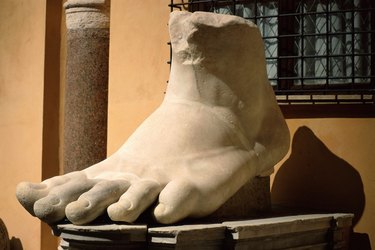
From the Latin word sculpere, the word sculpture literally means to carve. Sculpture artists create three-dimensional figures and forms that you can walk around or relief 3-D artworks that rise above a flat plane. Artists use multiple methods and techniques to create 3-D works, including carving, casting, modeling or a construction method that includes assembling various materials into a 3-D object. Some sculptures, called kinetic sculptures, even have moving parts.
Sculpture Elements and Principles
Video of the Day
The contour line of a piece of sculpture defines its outline or silhouette. In complex sculptures, there are many contour lines, artfully enhanced with both the use of negative space -- the empty area around the sculpture -- and positive space -- the space the sculpture occupies. In addition to form, line, silhouette and space, a sculpture's mass must be stable or balanced, with an aesthetically pleasing composition. Depending on how the artist creates the sculpture, it is created on a human scale or not, stationary and stable without movement, or appear as if it were caught mid-movement, like the Horse and Man sculpture in the Trevi fountain in Rome, Italy.
Video of the Day
Other Principles and Elements
Scale and proportion figure heavily into artists' sculptures. Most artists use mathematical ratios to create sculptures that ensure that each part of the sculpture is in proper proportion to its other parts. The scale of the sculpture is based on its relationship to its surrounding environment in the location where it is displayed. Some sculptures are created using a human lifelike scale, or they can be smaller or larger, depending on the statement the artist wants to make. Other elements and principles of sculpture include texture, light and color, the play of dark against light for contrast, repeated patterns and the rhythm of those patterns.
The Four Sculpture Types
Sculptures fall into four basic categories: molded, cast, carved or assembled. The media an artist uses for molded sculptures include clay, wax, papier-mache and plaster. Cast sculptures involve modeling the sculpture, then making a mold and casting it in a metal or other medium. Carved sculptures, such as Michelangelo's Pieta, took years to carve out of marble. Assembled sculptures pull bits and pieces -- some recycled -- from just about anywhere into textured forms that please the artist.
Artist’s Interpretation
Like all artwork, the medium the artist chooses for her sculpted creation is part of the depiction of the piece. Artists use sculptures to evoke an emotion or a response from the viewer through the materials they use, its form, colors, texture and mass or size. A child's Mouse Trap game is an example of a kinetic sculpture in action that players assemble as they move around the board, fashioned after a Rube Goldberg-type kinetic sculpture.