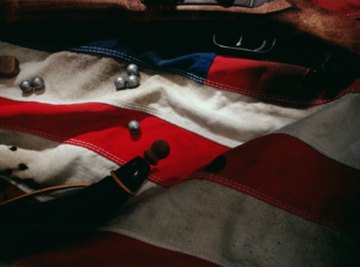

As the Second Amendments attests, gun ownership has been such a vital part of American culture since colonial days that the forefathers of the Constitution made certain gun ownership remained the right of every citizen. In North Carolina and the other colonies, colonials used guns to defend their homes against Indian attack, hunt game for dinner and even to make extra cash. They could kill animals and ship pelts to Europe for a hefty profit. Several types of guns were common during the colonial period and testament to the creative ingenuity of these early Americans.
Flintlock Fowler
The first gun crafted entirely in the colonies, the Flintlock Fowler was an early version of the modern day shotgun. The gun featured a light butt designed to easily fit the shoulder, allowing the user to focus evenly down the length of the barrel and greatly increasing accuracy. North Carolinians used the gun mainly for small game hunting there and the other colonies. While the Fowler was accurate, and easy to fire from horseback, the gun did have some severe drawbacks. Reloading in damp weather could cause a misfire or a blown barrel. Revolutionary War hero, and first U.S. Secretary of War, Henry Cox lost two fingers on his left hand when the barrel of his Fowler exploded. The invention of the percussion cap in the early 19th century by Scottish gunsmith Alexander John Forsyth eliminated most misfires as the result of reloading, rendering weapons like the Fowler obsolete.
Long Rifle
Known as the North Carolina rifle, among many other names, the long rifle was the standard hunting weapon of the colonial period. Believed to have evolved from the Jaeger rifle, which German gunsmiths brought to the colonies in the early 18th century, the long rifle was so named because of the weapon's long barrel. It measured anywhere from 44 to 60 inches in length. A longer barrel meant that a smaller caliber of bullet could produce the same amount of force when fired using a heavy load of gun powder, as a larger bullet could produce when fired with less powder. A smaller caliber bullet was cheaper for the colonists as they required less lead to manufacture. Owners often decorated long rifles with silver and brass inlays, and the rifles featured a brass patch box contained in the butt of the weapon. They used the patch boxes to store a variety of items, from extra cartridges to grease used to lube the rifle.
Swivel Gun
A remarkable piece of early engineering, the swivel gun featured two interchangeable barrels loaded with different shot. One barrel was loaded with small pellets used for hunting birds and small game, while the other barrel was rifled to fire a larger-caliber bullet for hunting bigger game. The rifled barrel had small grooves cut into the interior of the barrel, which caused the bullet to rotate when fired, allowing for greater range, stability and accuracy. To switch barrels, the hunter would unlock one barrel, rotate the second barrel into place, then lock that barrel into position. Since hunters could never be sure of what kind of animal may cross their paths, the swivel gun gave them the ability to quickly switch to the type of ammo best suited for killing whatever animal, or foe, they had down their sights.
Musket
Perhaps the best known weapon of the colonial period, the musket was not widely used in the colonies until the Revolutionary War. Since the British army did not furnish colonial militias with weapons, when the Continental Army began to form, men would bring with them whatever weapon they had at home. Due to the wide variety of weapons on hand, providing ammunition for each type of weapon was too difficult for the fledgling command. To solve this problem, the Continental Congress ordered that the musket become the official weapon in the army. However, getting enough muskets to arm each soldier became difficult. As a result, the American Musket was often cobbled together out of different parts of other guns. This practice continued until complete muskets began to arrive from Europe much later in the war.
References
About the Author
Timothy Lemke has worked as a freelance writer since 2009 and has been published with such websites as Ask The College Guy. Lemke graduated from the University of Missouri-Kansas City and possesses a Bachelor of Arts in European history.
Photo Credits
Jupiterimages/Photos.com/Getty Images