Rainforest canopies are made up of trees that grow between 100 to 150 feet tall. These tree tops take the brunt of rainstorms and trap much of this moisture between and under the interwoven tree branches, keeping the air beneath them warm and humid. Some animals have become specially adapted to live in this rainforest layer and a few rarely leave the safety of the canopy branches.
Spider Monkeys
Native of the Central and South American rainforests, the spider monkey lives its entire life in the rainforest canopy. Its prehensile tail, which can grow to be two to three feet long, is especially adapted to help it cling to branches, providing a valuable fifth limb. Spider monkeys are primarily vegetarian, eating a diet of fruit, nuts and leaves, but will eat insects as well. Spider monkeys can also be found in some rainforests in Mexico.
Orangutan
Sporting a coat of rather shaggy reddish fur, orangutans inhabit the rainforest canopies and swamps of Sumatra and Borneo. Male orangutans can grow to be as large as a human, weighing up to 250 pounds and up to five feet in height. They use their long arms to move from limb to limb through the trees in search of fruit, leaves, bark and the occasional insect.
Toucans
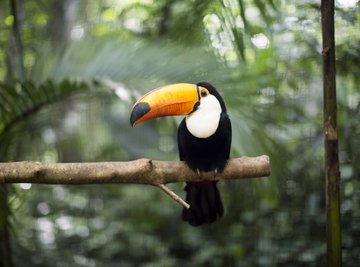
Boldly colored, large, thickly curved bills make toucans instantly recognizable. These birds are so comical in looks that a certain manufacturer uses one to brand its popular breakfast cereal. Native to the tropical and sub-tropical rainforests of Central and South America, these fruit and insect eaters live in hollowed out tree holes. Toucans can grow to between 12 to 24 inches in height.
Parrots
From the three-inch budgie birds, to the three-foot long macaws, parrots can be found in tropical rainforest canopies throughout the world. Bright, bold, beautiful and sometimes noisy, these canopy dwellers spend their lives in search of seeds, nuts and fruit. Some parrots nest in tree holes, others come down from the tree tops to lay their eggs in holes in the ground.
Sloths
Slow of movement and content to sleep up to 15 hours a day, the sloth is perfectly adapted to live in the rainforest canopy. Found in Central and South America, these animals dine exclusively on leaves and fruit and only come down from the canopy when necessary. Their long limbs have either three or five toes with long claws adapted to hold on to tree limbs. Sloths spend much of their time hanging upside down and their fur has adapted for this as well. Individual hairs grow from the stomach outward so that rain water will run off the sides of the animal while in its favorite position.
References
About the Author
Monica Wachman is a former editor and writer for FishersTravelSOS, EasyRez.com and Bonsai Ireland. She has an AA degree in travel from Career Com Technical and is an avid RV buff and gardener. In 2014, she published "Mouschie and the Big White Box" about an RV trip across North America.