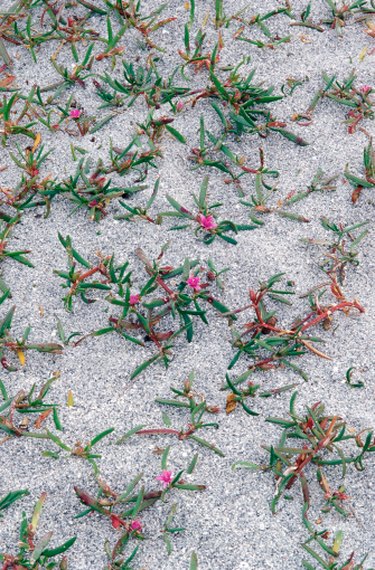
Moss is a species of nonflowering plant with a soft texture that grows close to the ground in a clumping or matting configuration. Many species of flowering plants have moss in their name, but they are not true moss plants. These flowering plants carry the name of moss because the plants grow in a moss formation. Landscapers use these types of flowering plants as ground covers in the garden or next to walkways.
Sandhills Pyxie-Moss
Video of the Day
Sandhills pyxie-moss (Pyxidanthera brevifolia) is an endangered creeping "subshrub" native to North and South Carolina. This evergreen plant belongs to the Diapensiaceae family. Sandhills pyxie-moss has small succulent basal leaves covered in tiny hairs that resemble a star. The perennial flowers of Sandhills pyxie-moss are solitary blossoms. The blossoms are pure white with five petals and yellow centers. Pyxie-moss blooms from March to April, according to the North Carolina Native Plant Society, although the North Carolina State University Libraries' website indicates a longer bloom period.
Video of the Day
Moss Phlox
Moss phlox (Phlox subulata) is a perennial ground cover indigenous to the eastern United States. This Polemoniaceae family plant grows to 6 inches in height with a spread of 2 feet. The needlelike evergreen to semievergreen foliage of moss phlox has a dense arrangement. The five-petaled flowers come in an assortment of shades, including pink, white, blue-purple and lavender. Moss phlox blooms early to midspring. Moss phlox thrives in full sun to partial shade and moist yet well-draining soil.
Moss Verbena
Moss verbena (Verbena tenuisecta) is a drought-tolerant, herbaceous, semiwoody plant belonging to the Verbenaceae family. This 6- to 12-inch-tall South American native has a low-growing formation with a spread of 3 to 6 feet. The evergreen, lacy, mosslike foliage has a medium green hue that often turns red during winter. The flowers of moss verbena bloom in the spring until summer. Moss verbena develops terminal clusters of a variety of purple and white shades. Plants growing in full sun tend to have a mat formation, whereas plants that live in the shade develop an upright configuration.
Moss Rose
Moss rose (Portulaca grandiflora) is a heat- and drought-tolerant annual originating from South America. A member of the Portulacaceae family, this herbaceous plant grows to a height of 6 to 8 inches. Moss roses have a spread of 6 to 12 inches and a spreading or cascading formation. Gardeners use moss roses as ground cover, in borders and as hanging plants. The flowers of the moss rose flourish summer to fall, and the 1-inch-long blossoms resemble roses. Moss roses come in shades of rose, red, white, yellow and orange.
- Duke University Extension; Sandhills Pyxie-Moss; Will Cook; 2011
- North Carolina State University Libraries: Pixie Moss Flowers
- University of Arizona Extension; Moss Verbena; August 2001
- Clemson University Extension; Verbena; Karen Russ; April 2004
- North Carolina Native Plant Society; Pyxidanthera brevifolia; May 2009