

Typical Roof Slope

When it comes to residential home construction, the slope of the roof is dependent on the design of the home, the type of weather in the area and, of course, the price of installation. In America, the national standard for roof slope, or pitch in industry terms, is 4-12, but homes may be built in the 1-12 to 60-12 range.
Geometry
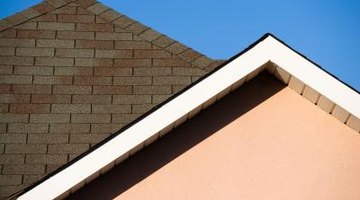
To understand the typical roof slope in the U.S., you must first understand how a roof's slope is measured. The first number in the two-number pitch description is the number of inches that rise for every inch of roof run, or length, which is the second number. For example, a 4-12 roof rises 4 inches for every 12 inches of roof run, or at an angle of 18.43 degrees. A roof in the 12-12 category is a perfect 45-degree angle.
National Standard and Trends
Throughout the U.S., 4-12 roofs are the most commonplace and are considered the national standard. However southern roofs are commonly built in the 3-12 pitch range, or at 14.04 degree angle. If a home's roof is in the 2-12 to 4-12 range, it is considered a low slope, while homes in the 4-12 to 21-12 category are high-sloped. Mansard roofs, which are built for aesthetic effect, have extremely steep roof slopes in the 21-12 to 60-12 range. To get an idea of how steep this is, a person cannot safely walk on a roof with a pitch higher than 8-12.
Styles
The slope of a roof is dependent upon the style of the roof itself. In the U.S., roofs are most often constructed as gable, hip or Mansard. A gable roof is a symmetrical roof that looks like an upturned, open book lying atop the frame of the house. Gable roofs can be any slope but are common in the 3-12 category. Hip roofs are low- to high-sloped roofs that are shaped like a trapezoid pyramid with four connecting points on each corner that meet at the top, or the ridge of the house. A Mansard roof, which is found on more traditionally styled homes, is a hip roof with extremely sloped sides that rise to meet a flat roof.
Warnings/Considerations
Less expensive to build than steep roofs, a low-pitch roof is nevertheless more problematic in winter climates because of snow and ice accumulation. If you live in areas with harsh winters, consider a roof in the 4-12 and up range. The higher the pitch, the less weather-related accumulation. If you already own a low-pitch home and ice and snow are common in your area, add an ice and snow shield to prevent ice damming.
References
Writer Bio
Leah Waldron is the head of Traveler Services at First Abroad, a gap year travel company based in Boston and London. As a travel, research and LGBT news writer, Waldron has publication credit on magazines and newspapers including "Curve Magazine," "USA Today," "The Sun Sentinel" and the "The Houston Chronicle." Waldron has a bachelor's and master's degree in creative writing from Florida State University.
Photo Credits
- Jupiterimages/Photos.com/Getty Images
More Articles

