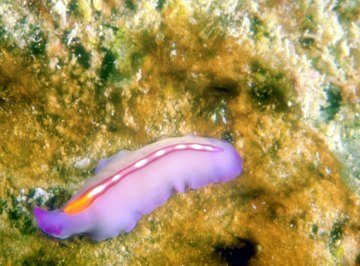

The term “worm” has been applied to thousands of diverse, unrelated invertebrate animals, including snakelike lizards called blindworms. However, for common usage, worm is a name generally given to elongated, soft and limbless animals such as flatworms and roundworms. While flatworms and roundworms share many similarities, they vary in numerous ways, including reproduction.
Flatworm: Platyhelminthes
Turbellaria worms are chiefly nonparasitic and aquatic, with some species living in humid terrestrial habitats. Monogenea, Cestoda and Trematoda are all parasitic worms. Monogenea worms are external parasites that infest aquatic creatures. Cestodes or tapeworms, and trematodes or flukes, inhabit the digestive systems of their hosts, which includes various aquatic and land animals, such as:
- fish
- humans
Flatworms generally range in size from 24 inches in length to microscopic.
Flatworm Reproduction
Generally all flatworms are hermaphroditic, meaning an individual flatworm has both male and female reproductive components. They engage in sexual and asexual reproduction, with the dominant mode of reproduction varying among species.
Asexually, flatworms procreate via fragmentation and budding. Fragmentation, also called cloning, occurs when a flatworm splits off a part of its body, allowing the separated portion to regenerate into a new worm. With budding, a flatworm grows an extension from its body. This extension, or bud, becomes a new worm and separates from the original flatworm.
There are also multiple methods of flatworm sexual reproduction. Because a flatworm is hermaphroditic, it can produce eggs within its body and also fertilize them with sperm, also generated in its body. Another method of reproduction involves physical contact between two flatworms, where the sperm of one flatworm is absorbed into the skin of another. With some species, this occurs through penis fencing, where flatworms use their penis to compete in trying to pierce the skin of a potential mother.
Ultimately, fertilized eggs are encased in a cocoon within a flatworm’s body. The cocoon is released into environments such as amid water weeds. The cocoon nourishes the eggs, which develop and later hatch.
Roundworms: Nematoda
Roundworm is the common name for members of the phylum Nematoda. While the reported number of Nematoda species greatly varies, there are at least 12,000 official species. Also called nematodes, roundworms are highly diverse, cylindrical-shaped worms that live in a wide array of terrestrial and aquatic environments. Roundworms come in segmented and unsegmented, parasitic and nonparasitic varieties. Roundworms usually range in size from 2 inches in length to microscopic.
Roundworm Reproduction
Unlike flatworms that are primarily hermaphroditic, roundworms have hermaphroditic and gender-specific species, with sexual reproduction being the dominant mode of procreation. With gender-specific roundworms, copulation occurs between the male and female; whereas hermaphroditic roundworms self-fertilize their eggs. Some roundworms bear live young, and yet most release their eggs into various habitats. The eggs develop into larvae, and depending on the species, may molt several times before maturity.
About the Author
Andrea Sigust began writing professionally in 1994, authoring user-friendly manuals, reference guides and information sheets while working at a hospital. After years of working in industries ranging from health care to telecommunications, Sigust became a writer. She specializes in the sciences and holds a Bachelor of Science in journalism from the University of Maryland.
Photo Credits
Jupiterimages/Photos.com/Getty Images