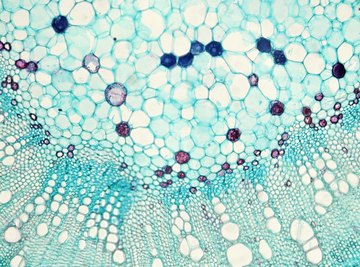
One of the complexities of life as a multicellular organism is that the trillions of bits and pieces that make up your body must somehow all work together to accomplish the basic functions that keep you alive. Biologists refer to the relationship between cells, tissues and organs as the levels of organization of the human body.
TL;DR (Too Long; Didn't Read)
In the human body, cells are the basic units of life. Groups of cells working together for a specific function form tissues. Organs are two or more tissues operating together. Even separate organs work together, forming body systems.
A Ladder of Complexity
It can be helpful to visualize the levels of organization as a ladder. Beginning at the bottom rung with the most basic component of the human body, you can imagine each subsequent rung as a new level of organization, building in complexity as you work your way up the ladder.
Cells in the Human Body
The simplest unit of life is the cell. In fact, some organisms like bacteria are nothing more than a single cell. The human body contains approximately 30 trillion cells and that is without considering all the unicellular bacteria that naturally colonize the digestive tract. Scientists estimate there are approximately 200 unique types of cells in the human body.
Cells Form Tissues
Groups of cells organized together for a specific function form tissues. There are four basic types of tissue in the human body: epithelial, muscle, nerve and connective. Epithelial tissue covers the exterior of the body as well as the linings of the organs and cavities of the body. Muscle tissue contains cells that are sometimes called “excitable” because they are able to contract and enable movement. Nerve tissue conducts electrical impulses and send signals through the body. Connective tissue holds the body together and includes both bones and blood.
Tissues Form Organs
An organ is two or more tissues that come together to form a single unit with a unique structure and function. The heart, for example, is an organ that contains all four types of tissue to accomplish its very important task. There are 78 organs in the human body, including five organs considered vital for life. These vital organs are the brain, heart, lungs, kidney and liver. The largest human organ is the skin, which can weigh around 20 pounds.
Of course, the levels of organization of the human body don’t stop with the organs. Individual organs work together in nine major organ systems. And, at the very top of the ladder, all those systems, organs, tissues and cells come together to form an organism: you!
References
About the Author
Melissa Mayer is an eclectic science writer with experience in the fields of molecular biology, proteomics, genomics, microbiology, biobanking and food science. In the niche of science and medical writing, her work includes five years with Thermo Scientific (Accelerating Science blogs), SomaLogic, Mental Floss, the Society for Neuroscience and Healthline. She has also served as interim associate editor for a glossy trade magazine read by pathologists, Clinical Lab Products, and wrote a non-fiction YA book (Coping with Date Rape and Acquaintance Rape). She has two books forthcoming covering the neuroscience of mental health.