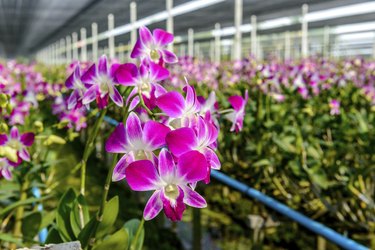
From the Arctic's frozen tundra to the equator's steamy jungles, nearly 30,000 orchid species -- falling under many genus -- have mastered the art of survival. For home growers, at least one orchid species survives outdoors in each of U.S. Department of Agriculture plant hardiness zones 2 through 12. Unfortunately, these mysterious, passion-inciting plants suffer from their share of pests and disease. When fluffy white stuff begins defacing their leaves and flowers, one or both are present.
Sap-Stealing Mealybugs
Video of the Day
Fluffy, white oval spots on an orchid's leaves, roots, rhizomes or pseudobulbs are mealybugs. Usually measuring less than 1/5 inch in length, their bodies are edged with fine filaments and covered in cottony, white wax. Mealybugs feed by inserting hollow, sharp oral tubes into the orchids and draining sap.
Video of the Day
Infested orchids weaken from loss of moisture and nutrients, and may start to shed leaves, flowers and buds. The mealybugs also excrete large amounts of undigested sap as a transparent, sticky fluid called honeydew. Honeydew attracts sugar-craving ants and sooty mold spores that cover the plants in greasy, black sun-blocking fungus.
Mealybug Management
To manage a small mealybug population, wipe all the above-ground parts of the orchid down with cotton swabs or balls dipped in 70-percent isopropyl rubbing alcohol. This kills the adults, and repeating the treatment over the next one or two days destroys recently hatched, yellowish nymphs.
Organic ready-to-use insecticidal soap spray suffocates mealybugs on indoor and outdoor orchids. Spray outdoor plants when they're out of direct sun and no honeybees are foraging nearby. Spray until the soap runs from all their surfaces and reaches into the leaf crevices and beneath the pseudobulbs' sheaths. Repeat every two to three days, or as often as the label recommends, until the infestation subsides. To protect yourself from drifting spray, wear a long-sleeved shirt, long pants, waterproof gloves and safety glasses.
Repot a container-grown orchid with mealybug-infested roots in clean, fresh growing medium. Remove it from its pot, rinse the roots of infested soil and spray them with ready-to-use insecticidal soap until they drip. Dispose of the old potting material, which may harbor eggs or nymphs.
Snow Mold Fungus
Snow mold fungus (Ptychogaster spp.) isn't technically an orchid disease. It emerges on the surface of the potting medium as a dusting of powdery white mold. A growing medium containing fir bark or tree-fern fiber is highly susceptible.
Untreated snow mold covers an orchid's roots and climbs its base. Water doesn't penetrate the fungus, so the roots eventually succumb to moisture, nutrient and oxygen deprivation. Victimized orchids grow poorly and frequently die.
Snow Mold Management
To save a snow-mold infested orchid, remove it from its pot, shake off the old medium and dip the roots, rhizomes and pseudobulbs in a solution of 2 teaspoons fungicide to 1 gallon of water. Use a fungicide with the active ingredient n-alkyl dimethyl benzyl ammmonium chloride.
Repot the orchid in a clean pot of fresh, bark-free orchid potting soil. Spraying the new medium once a month with the fungicide solution helps prevent new infection. If the snow mold reoccurs, drench the medium with the fungicide as soon as it appears. Always follow label directions for mixing and application.
- University of California Department of Agriculture and Natural Resources: Marin Master Gardeners Independent Journal -- Orchids for the Home
- Missouri Botanical Garden: Phalaenopsis (Group)
- American Orchid Society: Mealybugs on Orchids
- UC Statewide IPM Online: Mealybugs
- UC Statewide IPM Online: Pesticide Information -- Active Ingredient, Soap
- Florida Department of Agruculture and Consumer Services: Snow Mold, Ptychogaster Sp.
- Fort Lauderdale Orchid Society Newsletter: It's Not Too Soon to Repot
- American Orchid Society: Orchid Potting Media Reviewed