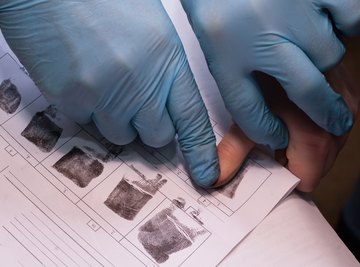

Forensic science is an interesting subject at the intersection of science and law. Through some simple science fair investigations, high school students can learn a lot about how forensic investigators gather and analyze clues at crime scenes. These science fair projects can explore, among other things, the proper analyses of fingerprints, bite marks and blood spatters.
Difference in Fingerprint Types Between Males and Females
Human fingerprints show many different patterns, such as arches, whorls and loops. The different types of fingerprints occur at different frequencies throughout the population based on certain biological factors. This project focuses on determining whether gender influences the frequency of the fingerprint types.
To complete this project, you will need fingerprinting pads and fingerprint charts where you can take fingerprints from different people and keep track of their genders.
Start by enlisting the help of 30 girls and 30 boys. Take the fingerprints from all of these test subjects. Count the numbers of arches, loops and whorls among the samples from the boys, and do the same for the girls. Perform a chi-squared test to determine whether there are significant differences in the various fingerprint categories. For the chi-squared test, use the numbers of fingerprint types for the boys as the expected values and the numbers of fingerprint types for the girls as the observed values.
Blood Spatter Patterns
Forensic investigators can determine a lot about the nature of a violent crime by analyzing the patterns in blood spatters. You can learn about what they can know by performing some simple experiments.
For this project, you should create a 50/50 mixture of corn syrup and water colored with red food coloring for use as "blood" in your investigation. You will also need an eyedropper, a large white poster board, a meter stick and a protractor. You will determine the lengths of streaks of blood created by drops of "blood" falling from different heights and at different angles to the poster board.
To collect data, prop the poster board against a wall and use the eyedropper to drop one drop of blood on it. Use your meter stick to measure the height from which the blood was dropped and your protractor to measure angle at which the blood struck the poster board. Then use the meter stick to measure the length of the blood streak that occurred when the blood struck the poster board. Write down your data. Conduct many more trials by varying the height from which the blood was dropped and record all your data in a table labeled "Height versus Spatter Length." Then select a constant height and conduct more trials while varying the angle each time. Record these data in a table labeled "Angle of Incidence versus Spatter Length." When you have recorded sufficient data, see whether you can determine algebraic or trigonometric relationships between height or angle and spatter length.
Bite Mark Analysis
Forensic odontologists can learn a lot about the victims and suspects involved in crimes by analyzing any bite marks that were discovered as evidence. A bite mark is as unique as a fingerprint. One good science fair project would be to determine whether there are any standard differences between the bite marks of males versus females.
For this project you will need 30 foam plates. Cut them in half to create 60 bite mark templates.
Collect data by asking 30 females of the same age to create bite marks by firmly biting down on the Styrofoam plates. Then ask 30 males to do the same. Measure the distances between the canines of each female bite mark and do the same for the males. Then draw a line on each bite mark that connects the rear-most molars. Measure the depths of all the female bite marks by measuring the distance from the front incisors to the rear-molar line. Do the same for the male bite marks. Calculate averages and standard deviations for the data from the females and males and compare the two. Look for differences that could be useful in identifying a male versus female bite mark.
When conducting this investigation, be sure to use soap to sterilize all plates before and after the bite marks are collected to avoid spreading germs.
References
About the Author
Timothy Banas has a master's degree in biophysics and was a high school science teacher in Chicago for seven years. He has since been working as a trading systems analyst, standardized test item developer, and freelance writer. As a freelancer, he has written articles on everything from personal finances to computer technology.