
Learning can be spiced up with some hands-on activities that make science exciting and can make learning much more effective. Investigatory projects, or science projects, teach people important ideas about their world and can also be a lot of fun. Read on for some investigatory project examples your kids will love!
Observing a Chemical Spectrum
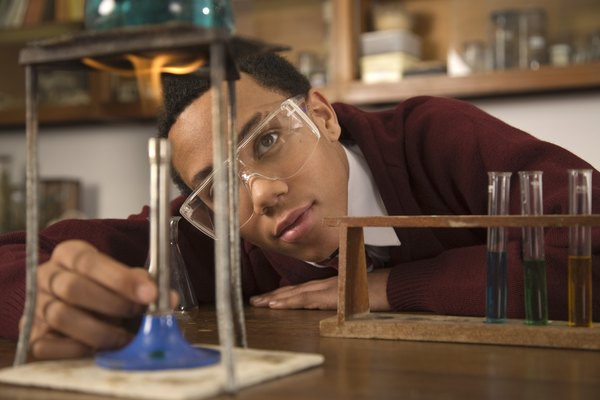
One investigatory project example that's a complex but very impressive project is spectroanalysis. "Spectroanalysis" is a fancy word for analyzing the spectrum of an object, usually given off when the object is burned. To perform this experiment, you'll need a Bunsen burner or other heat source, some things to burn, and a diffraction grating. You can obtain these supplies from Edmonds Scientific (see the link below). As for the objects to burn, wood, salt, sugar, and various nitrate salts work magnificently. Just make sure you have a few samples of each item.
Burn each chemical on a small wood stick individually and observe the color of the flame with and without the diffraction grating, which separates the flame into its component colors or spectrum. Observe that each chemical gives off a different spectrum. This spectrum can be used to identify the chemical very accurately. Each chemical emits a different spectrum when burnt. By recording this spectrum, you can identify a chemical based on how similar its spectrum is to known spectra given off by other chemicals.
The Capillary Effect
This is an investigatory project example that is fun and safe; it demonstrates the capillary effect, also known as capillary action. Lower a rolled-up paper towel into a glass full of water until about two centimeters of the paper towel are in the water. Observe how the water seems to flow up the paper towel, contrary to what one would expect. Eventually, the paper towel will become fully wet. This demonstrates capillary action, because the water has less of a cohesive force than that of the adhesive force between the towel and the water. Hence, the towel pulls water up, against gravity. This also works with a very narrow tube in place of a paper towel.
To add some color to the experiment, try putting food dyes in the water. Also, observe what happens when you put more than one type of food dye in the water. If you use two dyes of different densities, you should observe that the paper towel eventually separates the colors based on their differing densities.
The Curie Point
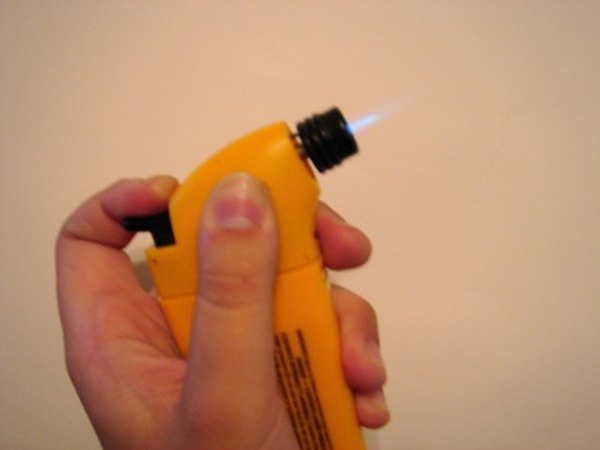
Permanent magnets all have a temperature at which they will lose their magnetism. This temperature is known as the magnet's Curie Point. This can be demonstrated easily with a few permanent magnets, some paperclips, and a propane torch. The demonstration should only be done by an adult familiar with the safe use of a propane torch.
First, take one of the magnets and prove that it is magnetic by using it to pick up a few paperclips. Now, use the propane torch to heat the magnet until it glows red. At that point, it should be past its Curie Point, which is probably around 840 degrees Fahrenheit. Let the magnet cool down, and then try to use it to pick up a paperclip. You should observe that the magnet no longer has any magnetic properties. This is because the heat has rearranged the magnetic particles present within the magnet. Prior to being heated, the particles were all aligned along one axis. Because each particle gave off a magnetic force, they complimented each other and created a large magnetic force along that axis. After being heated, the particles are randomly aligned and oppose one another, canceling out the magnetic force that they once produced entirely.
Magnetism Projects
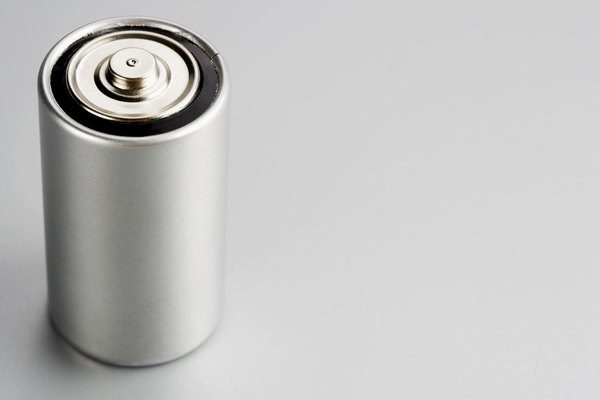
Another fun investigatory project example is the demonstration of magnetism, especially for younger audiences, as this experiment is both easy and safe. For this experiment, you will need a nail, a copper wire, electrical tape, a D-cell battery, and some paperclips. Take the copper wire and wrap it around the nail. Make sure the copper wire is relatively thin and that the wraps do not overlap but are as numerous as possible. Also, leave about five inches of wire on each side of the wrapped nail. Take the two ends that protrude from the nail and run them over to the D-cell battery. Use the electrical tape to secure one end of the wire to the positive terminal of the battery and the other end to the negative terminal. Run the nail over some paperclips to make sure that the magnet is working. As long as the D-cell battery is charged and attached to the nail via wire, a magnetic field will be generated. This demonstrates the property of electromagnetism, as the magnet you will have just made is an electromagnet.
References
About the Author
David Scott has been a firefighter for the Seattle Fire Department's Technical Rescue Team for almost 20 years. He has been writing primarily since 2005, but did author the book, "The White River Ranger District Trail Guide" in 1988. In addition to his work for Demand Studios, Scott spends much of his time writing poetry and a novel.