
School Project: Two Stage Rockets Made From Balloons

School Project: Two Stage Rockets Made From Balloons thumbnail
Rocket staging can be demonstrated wih a simple balloon experiment.

Rocket science is the butt of many jokes because of its notorious difficulty, but some aspects of this discipline are remarkably simple to understand. One of these aspects is rocket staging, a basic principle that makes rocket propulsion possible. Rocket staging can be fairly easily demonstrated with an experiment using two balloons.

  1. Tools You'll Need

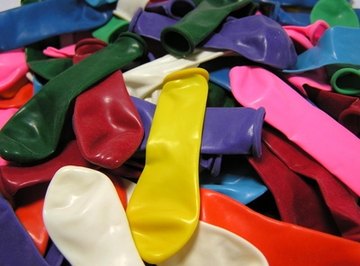
    • You will only need eight items for this project. First, you need two long party balloons like those used for balloon animals. You cannot use round balloons for this project; their shape limits the effectiveness of the experiment. Also, you need a roll of Nylon mono-filament fishing line of any weight, two stiff, wide plastic straws, one small Styrofoam cup, a roll of masking tape and scissors. This experiment is designed to be performed indoors.

    Set-Up- Part 1

    • To set up this experiment, cut off a 16-foot length of fishing line (or cut the fishing line to the width of the room where the experiment will be performed). Insert one end of the nylon fishing line through both of the straws. Tape one end of the string to one wall in your room, then tape the other end to the wall on the opposite side of the room. Cut the cup in half and discard the bottom half (you only need the top Styrofoam ring).

    Set-Up- Part 2

    • Inflate one balloon three-fourths full, and pull the nozzle end through the Styrofoam ring. Have a partner hold the ring and the first balloon, while you blow up the second balloon inside of the ring. The second balloon should be blown up halfway through the ring; the pressure of this balloon should hold the first balloon shut. Tape this balloon rocket to the straws - one balloon to each straw. Pull the balloon rocket carefully along the fishing line back to the first wall, holding the second balloon closed.

    Execution and Explanation

    • Release the second balloon. The rapid release of air from the second balloon will propel the rocket halfway down the line, then the first balloon will be released and continue to propel the rocket the remainder of the way down the line. This is the basic principle behind rocket staging. The first balloon to be released (the second balloon blown up) acts as a rocket booster, then the second balloon to be released (the first one blown up) finishes propelling the rocket with a second burst of energy in mid flight.

Related Searches:

References

  • Photo Credit Jupiterimages/Photos.com/Getty Images

Comments

You May Also Like

  • How to Make a Multi-stage Sugar Rocket

    Building your own rockets can be a lot of fun. It is important to work carefully and precisely to avoid a disaster....

  • Flying Experiments With Balloons

    Balloons were the first invention that gave people the ability to fly. Early balloons were made from the intestines and bladders of...

  • Stages of a Rocket Launch

    Stages of a Rocket Launch. Rockets are engines that produce their own propulsion using self-contained propellants, unlike car or airplane engines, which...

  • Ideas for Rocket Ship Birthday Cakes & Cup Cakes

    If your child dreams of flying into outer space one day, indulge him by throwing a rocket ship-themed party for his next...

  • How to Make a Rocket Balloon

    Rockets, for all of their scientific glory, are fairly straightforward inventions: propulsion generates thrust. With such simple mechanics, the most basic of...

  • How to Make a Paper Balloon Car

    Balloon cars are great for racing but can also teach different scientific principles. Balloon cars can be made using simple materials and...

  • Science Projects for Things That Fly

    People are fascinated by things that fly. Curiosity, adventure and a desire for flight has lead to the invention of machines that...

  • Rocket Projects for Middle School

    Rocket Projects for Middle School. Hands-on rocket projects and experiments can teach the principles of physics and chemistry to middle-school students. Rocket...

  • How to Make Balloon Pushed Rocket Cars

    Learn about Newton's Third Law of Motion and the science of rocket engines by building a balloon-propelled car. These cars are powered...

  • School Projects on Rockets

    Rockets are used in science exploration to help astronauts and other equipment propel into space. Children can learn about rockets and how...

  • How to Stuff a Pinata Out of a Balloon

    Spice up the average birthday party celebration with a piñata, a stuffed papier-mâché object that's filled with candy. The candy is scattered...

  • How to Build a Water Rocket

    Building a water rocket is a lot of fun as well as fairly simple. Water rockets are a great way to teach...

  • High School Balloon Projects

    A wide range of high-school projects and activities uses balloons as learning tools or visual aids. Balloons lend themselves well to several...

  • How to Make Paper Rocket Cars

    All rockets work using the same physical principles. From rockets going into space to missiles launched on Earth to simple rocket cars...

  • Why Do Some Air Conditioners Have Two Compressers?

    Air conditioning units with two compressors are more efficient and cheaper to operate than those with only one. Most newer model air...

  • How to Make a Brochure for a School Project

    Once a school project is completed, it's important that all the work that went into the endeavor does not go unappreciated. The...

  • Rocket School Projects

    A rocket is an engine that propels a vehicle, which can work in space without air. Rockets use either liquid or solid...

  • How to Build a Balloon Rocket Car

    A rocket moves at great speeds because gas under high pressure exits a nozzle at one end and pushes the rocket in...

  • How to Hold My Mouth Closed While Sleeping

    Sleeping with your mouth open leads to a dry mouth and increases your chances of snoring. Sleeping with an open mouth also...

Related Ads

Featured