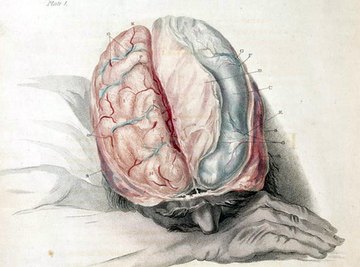

Scientists believe the brain's memory works by creating new synapses--connections between neurons--when it learns something. Information gets stored in the short-term or long-term areas of the brain.
Difference
The brain stores information in its short-term memory that it only needs for a few minutes, such as a phone number. Long-term memory contains data that the brain will use for years, such as how to use a telephone.
History
In 1885, Hermann Ebbinghaus became the first person to publish a scientific work denoting the differences between long and short-term memory. Ebbinghaus tested his memory of random syllables over a month and found he needed to keep repeating a pattern to successfully recall it later.
Fun Fact
Types of memory can occur in extremes. Two such cases have been studied by neuroscientists at teh University of California, Irvine. One is a woman who memorizes every detail of her life. On the other hand, a man in the study can only recall his last thought.
Misconceptions
Sometimes, short and long-term memory work in tandem, called the dual store theory of memory. An example of this would be memorizing a number quickly because of its similarity to a familiar number, such as a telephone number.
Tips
Short-term memories are not ideal for learning, thus educators advise against cramming studying into one night. People who "cram" information only remember about 30 percent of the following week, while those who take a piecemeal approach remember about 80 percent of the info they learned when tested the following week, according to “Memory: The Key to Consciousness” by USC neuroscientists Richard Thompson and Stephen Madigan.
References
About the Author
Russell Huebsch has written freelance articles covering a range of topics from basketball to politics in print and online publications. He graduated from Baylor University in 2009 with a Bachelor of Arts degree in political science.
Photo Credits
Image by Flickr.com, courtesy of Shaheen Lakhan