
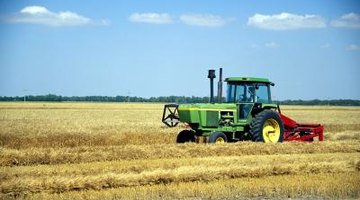


Agricultural engineers learn about basic science practices, engineering principles and how to design solutions for agricultural problems. If you receive a degree in agricultural engineering, you may get a job designing agricultural machinery, irrigation and drainage systems, or animal confinements. For this degree, you must solve problems and create new designs, so you can anticipate taking math, science and a wide variety of engineering courses in college.
Engineering Courses
As an agricultural engineer, you need a broad knowledge of engineering practices. In college, you may take classes on heat flow, water movement, fluid mechanics, properties of agricultural materials and engineering design. The principles behind this coursework are designed to provide you with a foundation for renewable resources, off-road equipment, water quality and soil management -- all topics related to agricultural engineering.
Other Courses
In addition to your engineering courses, you can anticipate taking many science and math courses as an agricultural engineer. At the University of California - Davis, agricultural engineering students must take calculus, vector analysis, linear algebra, differential equations, classical physics, general chemistry, organic chemistry, applied statistics and a variety of biological science courses. Students are also required to take English writing, public speaking and interpersonal communication classes.
Concentration
Depending on your university, you may be able to select a concentration within your major. This allows you to have a specialization related to your career interest. You may need to take extra classes to complete your concentration or simply focus your courses and electives in that specific area. At the University of Illinois at Urbana-Champaign, you can receive a concentration in renewable energy systems, off-road equipment engineering and soil and water resources engineering. For an off-road concentration, you will take classes where you design, manufacture, and test agricultural equipment; design machine components; and create equipment control systems for agricultural, construction, forestry and mining industries.
Internships
In addition to your in-classroom learning, as an agricultural engineer you most likely will be required to do field work. At California Polytechnic State University, agricultural engineers participate in the BRAE program. The mission of this program is to provide practical experience, which prepares students for work in the field. During this program, students obtain hands-on experience working on mechanical energy sources, water sources and hydraulics.
Related Articles






References
- University of Purdue: Agricultural Engineer
- California Polytechnic State University: BS BioResource and Agricultural Engineering (BRAE)
- University of Illinois at Urbana-Champaign: Agricultural & Biological Engineering Degree Paths
- University of Illinois at Urbana-Champaign: Off-Road Equipment Engineering
Writer Bio
Fitzalan Gorman has more than 10 years of academic and commercial experience in research and writing. She has written speeches and text for CEOs, company presidents and leaders of major nonprofit organizations. Gorman has published for professional cycling teams and various health and fitness websites. She has a Master of Arts from Virginia Tech in political science and is a NASM certified personal trainer.