
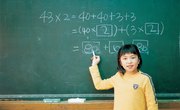
Singapore Math and Everyday Math are two competing methodologies for teaching mathematics to schoolchildren. In 2003, The Trends in International Mathematics and Science Study reported that students in Singapore ranked first in the world in tested mathematics achievement, while American students lagged in sixteenth place (with some of the lowest scores in the first world). Upon publication of the report, pilot studies in the United States began to test the curriculum’s effectiveness in this country.
Singapore Math Defined
Singapore’s Ministry of Education developed Singapore Mathematics, a progressive set of math curricula, for use in Singapore primary and secondary schools. Textbooks that teach this math--especially the primary series--generally cover a smaller number of math topics in greater depth than do American curricula. Particularly those intended for earlier grades tend to provide more in-depth coverage of a relatively small number of topics compared to many American textbooks. A broader, more integrated range of subjects emerges in the secondary level.
Everyday Math Defined
The University of Chicago School Mathematics Project originated Everyday Mathematics as a comprehensive curriculum for grades pre-K through 6. Whereas Singapore Math tends to present information in an isolated way, Everyday Math aims to connect math and mathematical problem-solving to the whole life of the child. Concepts are introduced broadly and integrated into real-life situations, and there is great emphasis on group learning.
Everyday Math Strengths
In 2005, The American Institutes for Research (AIR) study funded by the U.S. Department of Education set out to discover the functional differences between Singapore Math and Everyday Math so that the two systems’ strengths could be integrated. The strengths of the American curricula are in its whole-life integration. Whereas Singapore Math sticks to a rigid framework, the American system emphasizes reasoning: constructing connections between elements, communicating, and using applied maths such as statistics and probability.
Singapore Math Strengths
The touchstone of Singapore Math, as opposed to global learning, is solid conceptual comprehension. Singapore Math texts aim to teach mathematical concepts in a step-by-step process of deep understanding, instead of relying on simple and formulas as in Everyday Math. The rigid framework of Singapore Math seems to improve students’ test performance. (Notably, the same framework is not used for lower-achieving students; instead, an alternative system exists for this group that is paced more slowly and integrates more repetition.) Finally, Singapore Math tests are more technically difficult than those used in Everyday Math, thereby training the student in test-taking skills.
Singapore Math Effectiveness
The U.S. Department of Education Institute of Education Sciences (through its research arm, the What Works Clearinghouse, or WWC) looked at effectiveness studies of Singapore Math released between 1983 and 2008. The WWC concluded that none of the subject studies met its evidence standards. Since the studies are impossible to evaluate realistically, the WWC cannot definitively qualify the teaching methodology as effective or ineffective.
References
About the Author
Annette O'Neil is an air sports athlete, digital nomad, full-time traveler and yogini. A writer for more than a decade, O'Neil has written copy, content and editorial articles for hundreds of clients and publications, including Blue Skies Magazine and Whole Life Times.