All science projects should demonstrate a solid understanding of a scientific concept, whether that concept is the structure of an atom or the composition of a chemical formula. Sometimes science projects require building a detailed model or machine. Others involve experiments. One way to demonstrate understanding of a scientific concept in a science project is to conduct an experiment comparing two different substances, behaviors or abilities.
TL;DR (Too Long; Didn't Read)
Some science projects involve experiments. One way to conduct an experiment is to compare and contrast two different things. For example, you could compare the sweetness of sugar to artificial sweeteners, compare the vocal ranges of different people or compare how much food dogs consume when they're puppies versus when they are adults.
Sugar vs. Artificial Sweeteners
The purpose of this experiment is to see how the sweetness of sugar compares to the sweetness of artificial sweeteners. This science project requires: sugar, three artificial sweeteners of your choosing, distilled water, plastic cups, paper towels, cotton swabs, a stopwatch and at least four volunteers.
First, mix 1 teaspoon of sugar into a cup of distilled water, then mix three more cups of distilled water with a teaspoon of each of the artificial sweeteners. Have all volunteers rinse their mouths with distilled water, then pat their tongues dry with a paper towel. They should then dip a cotton swab into a cup of distilled water, and rub the water across their tongues. This gives them a baseline for comparing tastes.
With your stopwatch ready, have the first volunteer dip a fresh cotton swab into the sugar solution and smear it onto his or her tongue. Start the stopwatch as soon as the solution hits their tongue, then ask the volunteer to report as soon as they notice a change in taste. Measure how long it takes for the volunteer to notice a change in taste.
Have the volunteer wash out his or her mouth, then repeat with each of the artificial sweetener solutions. Have each volunteer go through the same process. Document how long it takes for each volunteer to sense a change in taste. From this data, create a chart or graph demonstrating the initial sweetness of each of the solutions. Present this graph or chart as part of the science project, along with other visual aides, such as photographs of the testing process and the sweeteners and sugars used.
Vocal Ranges of Different People
The purpose of this experiment is to compare the vocal ranges of different people and to find out if there are correlations between certain traits, such as age or gender and vocal range. For this experiment, you will need 10 volunteers -- five adults and five children -- and a piano or keyboard.
Starting with the middle C key, play each key on the piano or keyboard, and have the first volunteer match that note. Go up the scale until the volunteer can no longer hit the next note, and record the last note the volunteer could replicate, along with that volunteer's gender and age. Do the same thing going down the keyboard, to determine the lowest note the volunteer can hit. Do this for every volunteer, making certain to include each person's age and gender.
Use the recorded data to create an illustration of the data and conclusions. This may take the form of a chart, graph, or written explanation. Include a summary of how you conducted the experiment, to give your project's audience a deeper understanding of how you arrived at your conclusions.
Food Consumption: Puppies vs. Dogs
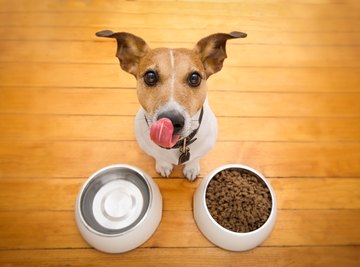
As a science project, compare the amount of food consumed in a single setting by puppies with the amount of food consumed by adult dogs. This project requires dog food, a measuring cup, a large dog bowl and access to three puppies and three adult dogs of the same breed.
Make certain that all dogs, both puppies and adults, are from the same breed for consistsency. The three adult dogs should be close to one another in age, as should the three puppies. It is essential that all dogs eat the same dog food, since different food could produce different results in the science project.
Fill the large dog bowl with three cups of dog food, and present it to one puppy. When the puppy has eaten the food, fill the bowl with another three cups and repeat until the puppy loses interest in eating the food. Record how much the puppy ate, then test the other two puppies. Repeat this process to test the adult dogs.
Wait around four hours before repeating the experiment again. Record the time of day for each feeding, along with your regular data. With this data, you can draw conclusions and illustrate your findings in graph, chart or written form. Include pictures of the dogs and puppies themselves, as well as information about the food provided them, all of which should help to engage your project's audience.
References
About the Author
Maria Cook is a freelance and fiction writer from Indianapolis, Indiana. She holds an MFA in Creative Writing from Butler University in Indianapolis. She has written about science as it relates to eco-friendly practices, conservation and the environment for Green Matters.