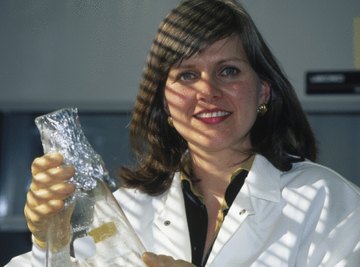

Reynolds aluminum foil is ideal for a variety of simple science projects. The students can even participate in recycling by asking their parents to let them bring in any unused aluminum foil for the experiments. On average, every person in America discards almost 3 lbs. of aluminum foil every year, according to Professor’s House.
Keeping Water Cold
Working alone or in groups, ask the students to test and compare the different insulating properties of a range of materials including aluminum foil, wax paper, butcher’s paper and bubble wrap. They should fill five plastic bottles of equal size with an equal amount of water and leave them for 12 hours in a fridge. After 12 hours, they should remove and wrap one in aluminum foil, one in wax paper, one in butcher’s paper, one in bubble wrap and leave one unwrapped. They add a thermometer to each and record the temperatures of each bottle every 10 minutes for two hours. By recording their results and plotting a graph, they will see that the foil keeps the water cooler longer.
Leaching Into Food
A common fear with many people is that aluminum from foil containers or foil sheets can leach into food during cooking or when food is wrapped cold in foil. Let the students experiment with foil to find out if this is true and teach them about the possible effects, such as proposed links to Alzheimer’s disease. Roll four squares of aluminum foil into similar sized balls. Drop one ball of foil into each of four small cups containing lemon juice, vinegar, distilled water and Coke. Soak them overnight and then test the liquids by adding ascorbic acid powder and bleach powder to see which ones absorb the most aluminum. The solutions which absorb the most aluminum will turn an orange-red color. The results should indicate Coke and vinegar to be the most absorbent. Explain that this relates to their high acidity.
Corrosion
Show your students the basic process of corrosion by cutting out a small square (a few inches will do) of foil and putting it flat in the bottom of an empty glass. Put an old copper penny on top of the foil square and carefully fill the glass with tap water so the coin and foil do not move. Wait about 24 hours or until the next lesson and you should see cloudy water. Pour out the water, remove the coin and show the students the perforated foil. It will have been eaten away by its reaction with the water, but the coin will have preserved the section underneath. The cloudy water is from the dissolved aluminum.
Solar Oven
Make a solar powered oven to illustrate to the class how solar energy can be used as a heat source and how solar powered ovens or other household appliances, such as hot water boilers, can reduce carbon emissions, which damage the ozone layer. Make the oven from two cardboard boxes and some Reynolds aluminum foil. The outer box needs to be big, such as the size that would fit a desktop computer, and the inner box should be about 15 by 15 inches. Fit the small box into the larger box, with newspaper as a support. A simple sheet of cardboard makes a useful lid. Fit another piece of cardboard to the inside base of the larger box like a drip tray. Cover the drip tray with a sheet of foil which has been painted with black craft paint on one side. Fit the foil painted side up. Also cover the inside of the larger box with unpainted foil. Glue the pieces together using ordinary white glue. Cookies are a safe option.
References
About the Author
Natasha Parks has been a professional writer since 2001 with work published online and in book format for "Thomson Reuters," the "World Patents Index" and thomson.com. Her areas of expertise are varied and include physics, biology, genetics and computing, mental health, relationships, family crises and career development. She holds a Bachelor of Science in Biophysics from King's College, London.
Photo Credits
Hemera Technologies/Photos.com/Getty Images