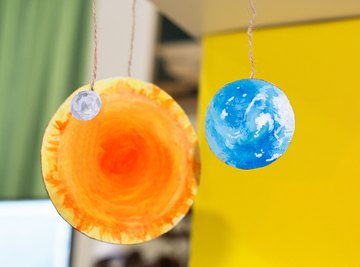

Construct a 3-D model of the sun, Earth and moon that accurately depicts the relation between the orbiting bodies in space for a school assignment or a decoration for a child's room. It can be built using cardboard and other items you have around your classroom or home, with minimal setup.
- 1-foot round cardboard piece
- Blue, yellow and white sheets of construction paper
- Scissors
- Tape
- String
- Pencils, crayons or markers
- Compass
Any size model you construct is not going to be to scale. To make a scale model, if the sun were a ball eight inches in diameter -- the size of a standard bowling ball -- the Earth would be the size of a peppercorn and the moon, a pinhead. At this scale, the Earth would have to be placed 78 feet from the sun. Therefore, practicality necessitates creating a non-scale model of the sun, moon and Earth.
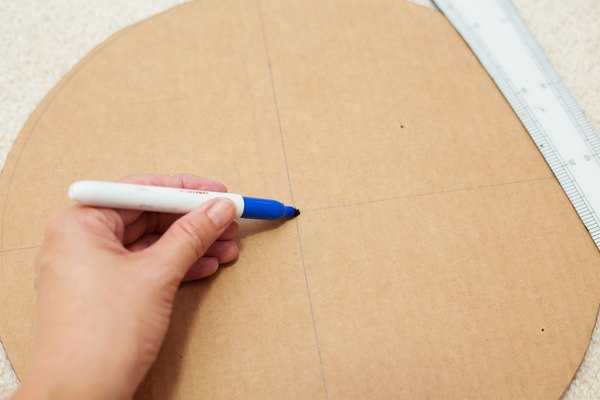
Locate the center of a round cardboard piece and mark it with a pencil, crayon or marker. Draw vertical and horizontal lines that intersect at the center.
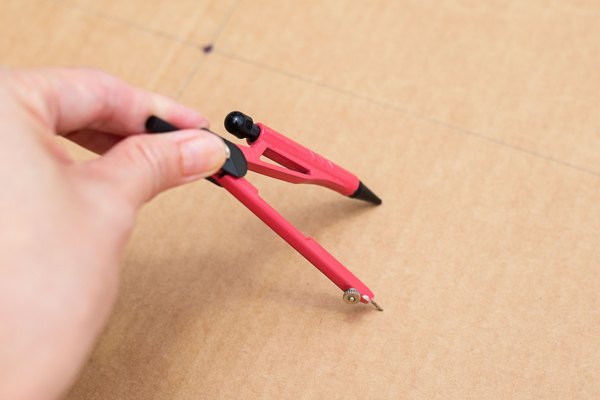
Use a compass to draw two circles, representing the distance between the sun, Earth and moon. The distance between the sun and Earth should be much farther than the Earth's distance from the moon. A circle for the sun is not necessary, as it will hang from the center of the cardboard.

Poke a hole in the center of the cardboard with a pair of scissors. Poke two more holes anywhere along the perimeter of each circle.
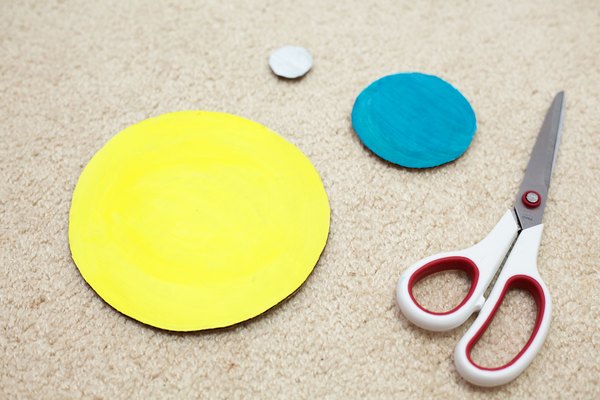
Cut a 6-inch circle out of yellow construction paper to represent the sun. Cut a 3-inch circle out of blue construction paper to represent the Earth and a 1-inch circle out of white construction paper for the moon.
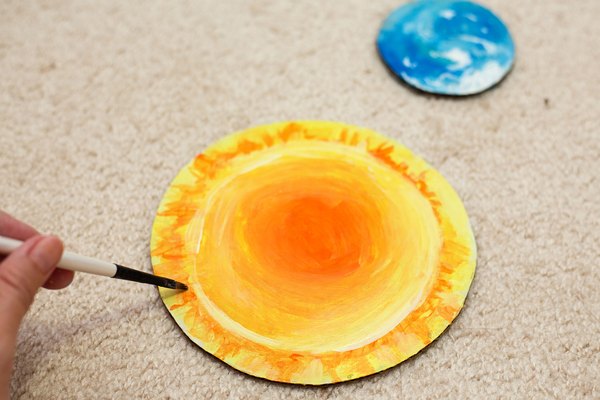
Decorate the circle pieces with crayons or markers. Draw flames that radiate out to the perimeter of the sun. Draw the land shapes of the Earth using a brown marker and the moon's craters with a gray marker.
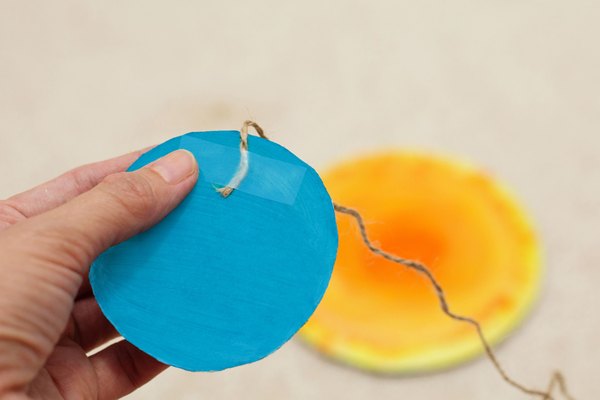
Cut three 6-inch pieces of string and tape one each to the sun, Earth and moon. Route the sun's string through the center of the cardboard, the Earth's through the second hole and the moon's through the third. Tape each end to back of the cardboard circle to complete the model.
Things You'll Need
Tips
References
Tips
- Any size model you construct is not going to be to scale. To make a scale model, if the sun were a ball eight inches in diameter -- the size of a standard bowling ball -- the Earth would be the size of a peppercorn and the moon, a pinhead. At this scale, the Earth would have to be placed 78 feet from the sun. Therefore, practicality necessitates creating a non-scale model of the sun, moon and Earth.
About the Author
Based in Florida, Robert Ceville has been writing electronics-based articles since 2009. He has experience as a professional electronic instrument technician and writes primarily online, focusing on topics in electronics, sound design and herbal alternatives to modern medicine. He is pursuing an Associate of Science in information technology from Florida State College of Jacksonville.
Photo Credits
Santy Gibson/Demand Media