
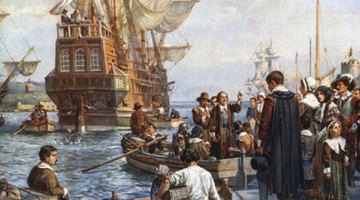

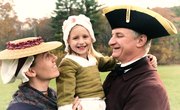
Permanent European settlements began to appear in America in the early 1700s, although San Augustine was founded in 1565. The English, for example, established their first colony at Jamestown, Virginia, in 1607 while the French began arriving in Florida in 1608. Although many of the colonies faced hardships, like disease and food shortages, settlers developed a distinctive way of life that was very different from the modern world.
Religion
The colonies were home to a wide range of religious practices and beliefs. Many of the early settlers in the northern colonies were Puritans, who enforced strict moral codes, plain clothes and disapproved of entertainment, like dancing. People of other religions also settled in early America, like the Quakers, who arrived in Pennsylvania in 1656, and the Lutherans from Germany.
Housing
When families arrived in the colonies, housing was their first priority. The first colonial homes were simply constructed from timber and topped with a thatched grass roof. Heavy, wooden shutters were used over windows, and chimneys were constructed with logs daubed over clay. Inside, the fireplace was the center of the home, providing heat and light. Household utensils, like cups and spoons, were often carved from wood by the men of the family.
Daily Life
For many colonists, daily life revolved around farm work. Without a supermarket to buy food, colonists had to rely on themselves to produce food, often through raising livestock and planting fruits and vegetables. The working day would often start with a stiff drink of cider or rum. Colonial men would then perform the outdoor duties, like planting crops and building fences, while the women milked cows, cleaned and prepared food. Outside of work, colonial families attended church and other public gatherings and relaxed around the fire at home.
Education
Education was provided for children throughout the colonies. Education for girls was often to limited to learning domestic skills at home, but richer families would hire a governess to teach girls reading, writing and arithmetic. In contrast, boys would often be taught to read and write, as well as a specific trade, like that of a blacksmith, at a local community or village school. Boys from richer families might also learn a foreign language, history and natural sciences, like biology. All children would undergo some religious education, often focusing on the Bible, that could be carried out at home or at a school.
Related Articles


References
Writer Bio
Kaye Jones has been a freelance writer since 2009, specializing in history, education and mental health. Her undergraduate dissertation was published by the Internet Journal of Criminology. Jones has a first-class honors Bachelor of Arts in history from the University of Manchester.