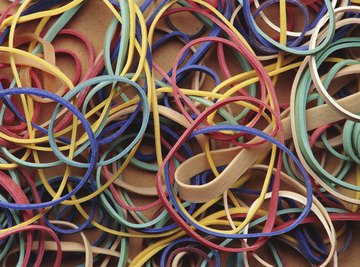

Many things in nature behave in fairly predictable ways, and predictability lets you make educated guesses about the world around you. For example, you can make predictions about temperature and its affect on objects: heat expands, cold contracts. Watch a cake in an oven, for example, and you notice that it expands as the batter heats up. Oddly, however, a rubber band does the opposite, contracting when warm.
Unexpected Contraction
If you heat a rubber band with a hair dryer, you'll notice that it contracts. It shrinks because of the unusual molecular properties of rubber. Rubber bands also become more brittle when hot -- something you might associate with cold because you've seen ice shatter when something solid hits it.
Molecules and Motion
Many everyday objects, including rubber bands, are made up of molecules. Molecules are tiny particles made up of atoms. In solids such as rubber, molecules normally fit together in one set shape. A rubber band consists of millions of rubber molecules arranged in a strip and joined at both ends. Molecules are affected by temperature, vibrating and jostling faster with more heat and more slowly when cold.
Room-Temperature Rubber
At room temperature, a rubber band snaps back due to its elastic molecular properties. The strands that make up the rubber band stretch, but forces in the rubber molecules pull them back to their original shape. When relaxed, the strands roll into tiny tangled balls. When stretched, the strands straighten out.
Effects of Heat
If rubber behaved like other substances when warm, it would expand. However, because of the arrangement of the rubber molecules, the band becomes smaller. Heating them "unwinds" the tangled balls, making the molecules less bunched and more strand-like. In this form the molecules take up less space and the rubber band shrinks.
Effects of Cold
The converse is also true. If you cool down a rubber band, it becomes stretchier and expands slightly. This is because the molecules organize into a more efficient stretching shape. Because the molecules are more rigid and structured, they are stronger.
References
About the Author
Grahame Turner has worked as a freelance writer since 2009 and a freelance reporter since 2010 for Wellesley Patch and Jamaica Plain Patch in Massachusetts. He also works part-time as a bookseller at the Northeastern University bookstore. He is a Northeastern University graduate with a Bachelor of Arts in English.
Photo Credits
anopdesignstock/iStock/Getty Images