
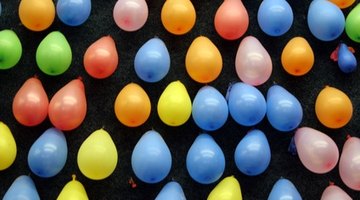


A school fair usually takes place at a school, and various games are played to win prizes. You might also find food, face painting, magic tricks and shows. When planning a school fair, be sure to include games that can be played be various age groups.
Balloon Bash
Balloon Bash is played by throwing darts at balloons to see how many you can pop. Using push pins, place balloons, spaced equally apart, along a board or wall. The player receives three darts, and the more balloons the player pops, the better the prize will be.
Lollipop Draw
This game is directed at small children. When you have three or more children, have each one draw a lollipop from your hand. The child with the lollipop that's marked wins a prize. The other children will still get to keep the lollipops as a prize, so they don't go away empty-handed. The school mascot, or a clown, can hold the lollipops.
Cake Walk
This classic game can be played by children and adults of any age. Place five chairs in a circle, but begin play using six players. Start by playing music, and as the music plays, the players will walk around the chairs. When the music stops, the players must sit on a chair. Whoever doesn't get a chair is out. Then a chair is removed from the circle, and the game continues in the same way as before, until only one person remains. His or her prize is the cake or pie of their choice.
Pie the Principal
In this game, the child will play against the principal or another teacher. The game host will think of a number and write it down. The number will be hidden where the child and principal can't see it. Each player will guess what the number is, and whoever is closer wins. The prize is getting to throw a cream pie at the face of the other player. Keep plenty of towels nearby.
Feed the Mascot
Create a large painting, or photograph, of the school mascot, with a hole cut out for the mouth. The player will be given three bean bags to throw into the mouth. The more bags thrown into the mouth, the better the prize will be.
Creepy Cafeteria Lady
Dress the cafeteria lady up to look creepy, perhaps with frizzy hair with bugs in it, fake green teeth or stained clothing that doesn't match. Design an apron that has about 12 pockets with numbers on them. Each child can choose a pocket to pick from. Each pocket should contain a different prize. Prize ideas: fake bugs, fake moldy cafeteria food, restaurant coupons and bookstore gift certificates.
Related Articles





Writer Bio
Kristal Smith has been writing for the web for more than six years. Smith holds a visual communications degree, with a photography specialty. She graduated from Ivy Tech College in Evansville, Ind. Her articles specialize in health, nutrition, photography, Internet and web design.