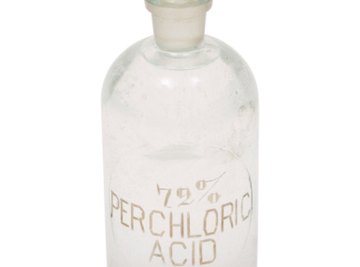

The charged chemical species known as ions are crucial in many different aspects of biology, industry and science. An example of an important ion is the positive hydrogen atom, H+, which is responsible for making solutions acidic. Electrolytes and ions are related by a basic principle; electrolytes are the chemicals from which ions are made.
Ions
Normally, an atom of a given element has an equal number of protons and electrons. Protons are the heavy, positively charged particles found in the atom's inner nucleus, while electrons are light and negatively charged and orbit the nucleus. This means that there is no overall charge to the atom. In some cases, though, an atom or group of atoms can lose or gain electrons and acquire a charge as a result. These charged chemical species are known as ions.
Electrolytes
Chemists use the term electrolyte to refer to any chemical compound that produces ions when it is dissolved in water. This happens when the molecules of a chemical essentially break apart as the chemical dissolves, producing charged ions, which are fragments of the original neutral molecule. Because some portions of water molecules are slightly positive and others slightly negative, water tends to be able to help this process by gathering around the charged ions and helping pull them apart.
Types of Electrolytes
There are two different types of electrolytes, based on the degree to which these compounds break apart in solution. Strong electrolytes break apart entirely, with every molecule dissociating into its constituent ions. An example is salt (NaCl), which dissolves to produce sodium ions (Na+) and chloride ions (Cl-). Strong acids such as hydrochloric acid (HCl) also do this. With weak electrolytes, only a fraction of the dissolved compound breaks into ions; the rest stays intact. An example of a weak electrolyte is acetic acid, CH3COOH.
Electrolyte Applications
Since ions have many important applications, it follows that there are just as many uses for the electrolytes that make those ions. The human body uses electrolytes such as salt to produce the ions (such as sodium) that are essential for various metabolic processes that support life. Solutions of electrolytes that result in the ions of zinc and copper find applications in batteries where they conduct current. Various electrolytes that are also acids and bases—both weak and strong—are very important and have many uses in industry and science, from the processing of metals to the manufacture of other chemicals.
About the Author
Michael Judge has been writing for over a decade and has been published in "The Globe and Mail" (Canada's national newspaper) and the U.K. magazine "New Scientist." He holds a Master of Science from the University of Waterloo. Michael has worked for an aerospace firm where he was in charge of rocket propellant formulation and is now a college instructor.
Photo Credits
PhotoObjects.net/PhotoObjects.net/Getty Images