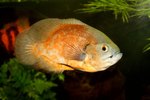
Caring for an aquarium full of fish can be exciting, especially if the aquarium contains sharks, but raising these creatures requires a great deal of advanced fish-keeping knowledge. Bringing in a baby shark does not mean the process of keeping it will be any easier; however, there are certain facts about some of the most-common species for aquariums that hold true whether the baby shark is more closely related to a great white or a guppy.
Not All Baby Sharks are Sharks
Some of the most common pet "sharks" are freshwater species of barbs and minnows that
True shark species often kept in large home aquariums include two species of small wobbegong, Ward's and tasseled, the epaulette shark and any of the bamboo sharks.
True Shark Babies are Bigger
Warnings
Even though the wobbegong, bamboo and epaulette sharks are smaller species as adults, "small" can be relative. Buy the tank any shark or fish will require as adults to avoid health troubles from growth stunting.
"Freshwater sharks" and true sharks are often sold as fry a couple of inches long with the expectation from the new hobbyist that they will only grow a little more and top out far less than a foot in length. In other words, they are bought to be raised in fish-sized aquariums. However:
- Bala sharks grow up to 14 inches and require schools of around six to be healthy and happy.
- Rainbow sharks and red-tailed sharks both grow up to 6 inches and should be housed alone due to aggressive tendencies.
- The tasseled wobbegong, one species often claimed as a pet, is around 7.9 inches at birth and grows to 4 feet long.
- The white-spotted bamboo shark hatchling is between 3.9 and 4.9 inches with an adult length of between 23.6 and 31.5 inches.
Both true sharks and freshwater "sharks" will grow quickly in their first year or two of life and may reach half their adult size. For example, the bamboo shark puts on at least a foot of its adult length in the first year alone.
Where Baby Sharks Come From
Shark matings are well-documented events in the wild or in captivity. Freshwater sharks breed differently. The rainbow shark and red-tailed shark rarely breed in captivity due to their aggression. Bala sharks can breed in their aquariums but are egg-layers who fertilize the eggs outside of their bodies. This puts the eggs at risk if other fish are in the same tank, even other balas, as the eggs will be eaten. Placing them in their own tanks to breed and removing the parents afterward makes for good husbandry.
Baby Shark Habitats
Warnings
Aquariums of more than 100 gallons can cost in the hundreds or thousands of dollars and weigh a half-ton once filled with water. Always have a tight top for the aquarium to keep the fish from jumping out to their deaths, even accidentally.
Freshwater sharks live in warm, freshwater areas such as streams and rivers in Thailand, Indonesia, Malaysia and other tropical climates. They require:
- pH ratings between 6.5 and 7.5
- Water temperatures between 72 and 84 degrees Fahrenheit
- Soft water
Babies hatch into these waters and school briefly for safety, often hiding in and around logs and plants under water, where they will continue to hide even after they have gone their separate ways to avoid aggressive members. Setting up an aquarium habitat with these items in mind is a necessity. All three of these species require space in an aquarium; 150 gallons is not unheard of for the bala shark with its desire to school.
Shark babies such as the wobbegong will need enough room for their 4-foot-long bodies to be comfortable, while epaulette shark babies are content with smaller, safer aquarium confines. Bamboo sharks, wobbegongs and epaulette sharks all originate from the Pacific Ocean in places such as Australia, Indonesia, India, Sri Lanka and all the way up into China. They require:
- Warm, shallow saltwater (70 to 80 degrees Fahrenheit)
- Coral reef setups
- Tank length of at least 8 feet
Omnivorous Sharks?
Warnings
Hand-feeding true sharks with live bait should never be done even in captivity and even with babies. Use a sharp stick with the fish to avoid nasty bites or allow them to hunt on their own.
Although true shark species are almost all carnivorous, with the teeth to prove it, their diets can vary according to species. Baby wobbegongs eat like their adults do, according to Cathleen Bester of the Florida Museum of Natural History Ichthyology Department:
"When unsuspecting fish comes within reach, the tasselled wobbegong pulls its jaws apart and literally sucks the prey into its mouth where the needlelike teeth pierce its flesh, giving no chance for escape."
Prey items for babies include:
- Tiny invertebrates such as shrimp and squid
- Small live fish
Freshwater sharks, however, have no teeth and therefore have a different diet. Rainbow sharks, red-tailed sharks and bala sharks are omnivores in that they will eat anything that comes into the tank and require varied diets including:
- Freeze-dried bloodworms
- Pellets
- Flakes
- Live food
- Algae disks
Writer Bio
Dondi Ratliff is a certified secondary English teacher in Texas. Her articles typically cover topics regarding animals both wild and domesticated. Ratliff holds a Bachelor of Arts in English from Tarleton State University, a Master of Arts in teaching from Texas Woman's University, and a Master of Arts in English from Tarleton State University.