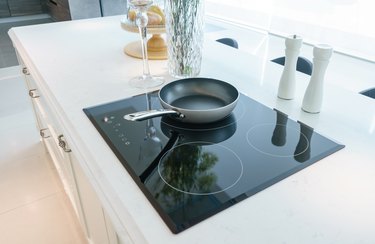
In more modern homes, you'll find ceramic-glass cooktops, and if you're not familiar with cooking on them, then you may not know the best ceramic hob pans to use. Ceramic-glass cooktops can look beautiful in updated kitchens, but you want to make sure you know how to use them properly. The first line of defense when taking care of a ceramic-glass cooktop is knowing the best cookware for electric glass top stove cooking.
What Are Ceramic-Glass Cooktops?
Video of the Day
According to Elan Technology, ceramic-glass is a mechanically strong material that can withstand repeated and rapidly changing temperatures. It has high-temperature properties and much higher strength and toughness than glass materials. Although it has higher strength and toughness than glass materials, you still have to be careful operating ceramic-glass cooktops because they are brittle.
Video of the Day
Best Ceramic Hob Pans
When choosing the best ceramic hob pans, stainless steel is a popular and recommended option. When shopping for stainless steel pans, you want to make sure that it has a clad bottom. According to All-Clad, all-clad pans or other clad pans use aluminum and stainless steel to get the best properties of both.
When looking for stainless steel pans, make sure they have a sandwiched clad bottom. According to The Cook's Warehouse, this means that the pan is made from a thick layer of aluminum that is sandwiched between two thin layers of stainless steel. These two layers are bonded together using high pressure. Cookware bottoms that are sandwich clad have the best of both worlds, with the stainless steel providing durability and stability, and the aluminum or copper allowing great heat conduction and distribution.
Heavyweight aluminum is another option that is highly recommended. This material has faster heat conduction than other metals, and it allows whatever you're cooking to be cooked evenly. The only con about aluminum is that the residue looks like scratches on the cooktop. To rectify this, all you have to do is clean it up as soon as possible.
Read more: Dangers of Ceramic Cookware
Okay Ceramic Hob Pans
If you have copper bottom pans, they are a good option when cooking on a ceramic stove, but they come with their own set of issues. These copper bottom ceramic hob pans leave residue on the cooktop that will initially look like scratches. If you notice residue on your countertop, clean it immediately. Also, when cooking with a copper bottom pan, make sure that it does not get overheated. Overheated copper bottom pans will leave a permanent stain on the cooktop.
Porcelain/enamel pans and porcelain-coated cast iron cookware is also another okay option. According to GE Appliances, if you are looking to purchase a porcelain/enamel pan, you have to make sure that it has a thick, flat bottom for it to work well on the ceramic stove top. You mustn't boil these pans dry because porcelain will melt and fuse to the ceramic stove top. When purchasing porcelain-coated cast iron cookware, make sure that it is completely coated with porcelain enamel. If you have cast iron cookware that isn't covered, you're at risk of damaging your stove top.
Also, when cooking with porcelain-coated cast iron, make sure that you're not cooking at high heat for long periods. This material holds heat well, and if the temperature exceeds what the glass stove top can handle, it will cause the stove top to override the cooking and shutdown. You never want this to happen because that means your surface temperature is super high, and your cooktop cannot handle that at all. Carbon steel cookware and titanium cookware are also okay options when cooking on a ceramic stove top. With carbon steel cookware, you want to make sure that the cookware has a flat bottom and is smooth so that you won't scratch the surface of the cooktop.
Not Recommended Ceramic Hob Pans
According to Cooking for Engineers, unlike gas stoves, where a majority of pans can be used, some pans are not the best cookware for an electric glass top stove. When it comes to glass top stoves, you should not use glass, ceramic, stone or pure cast iron cookware. Glass or ceramic cookware looks beautiful, but it can easily scratch the surface of a glass stove top. Also, glass is a poor conductor of heat, so it will take a lot longer for you to cook dishes, and you'll have to hover over your food to make sure it cooks properly.
Stoneware is another cooking material that is known to scratch ceramic stove tops, and it is just a poor cooking material overall. If you like using cast iron, never use pure cast iron cookware on a ceramic hob. If your pure cast iron cookware has a rough spot, then it will damage your glass surface. Also, cast iron is super slow at absorbing heat, but when it does, it holds a lot of heat just like porcelain-coated cast iron. If your cast iron gets super hot, which most likely it occassionally will, it will cause the stove top to shut down in response to the high temperature.
Read more: Cast Iron vs. Cast Aluminum
Testing Cookware Tips
According to GE Appliances, you want to make sure that your cookware has a flat bottom surface. If you want to test that your cookware is in tip-top shape, there are two tests that you can conduct. The first is the ruler test, and the second is the boiling water test. For the ruler test, you're going to turn your pot or pan upside down and place the ruler across the bottom of the pan. If you have a good pot or pan, then the ruler should sit evenly on the entire surface. If the pan is slightly concave in the middle, that is okay.
For the boiling water test, you're going to place a pan on a heating surface with 1 inch of water in it. Boil the water on high and watch to see where the bubbles are in the water. If the bubbles are clustering on one side or in the middle, then you don't have even heat distribution, meaning your pan likely isn't flat and isn't suitable for a ceramic-glass cooktop.