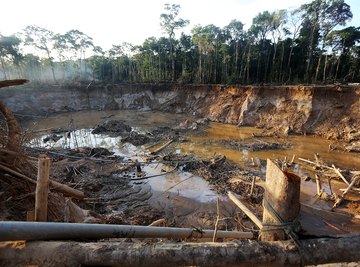
Gold has been a popular and valuable component of jewelry for centuries, but what is the environmental impact of gold mining? Gold is resistant to solvents, doesn't tarnish and is incredibly malleable, so it can be shaped with relative ease. Although its price fluctuates, gold regularly sells for more than $1,000 per ounce. Gold nuggets are popular among collectors but are rare; most gold is found as small particles buried in gold ore. However, mining just an ounce of gold from ore can result in 20 tons of solid waste and significant mercury and cyanide contamination.
Water Contamination from Gold Mining
Some gold can be found by panning in rivers; heavy gold will remain in the pan, whereas less dense rocks and minerals float out. This small-scale form of gold mining has little effect on the body of water, but the large-scale practice of mining gold from ore can have tremendous negative effects on water quality.
Gold typically sits in ore and sediment that contains toxins such as mercury. When rivers are dredged to mine large placer deposits of gold, these toxins float downstream and enter the food web, as they have done in California's South Yuba River, according to the United States Geological Survey.
Poisoned Drinking Water
Water contamination negatively affects not only wildlife populations but also human populations. Two open-pit gold mines in Montana closed in 1998 but continue to cost the state's taxpayers millions of dollars in reclamation and water-treatment efforts.
Cyanide used at these mines to leach gold from ore resulted in such high levels of pollution that people cannot use nearby water resources until they have been subjected to extensive and expensive treatment and purification. Reclamation efforts at the former mines are expected to continue indefinitely.
Destruction of Habitat
Most forms of gold mining involve moving massive amounts of soil and rock, which can be detrimental to the surrounding wildlife habitat. The United States Environmental Protection Agency estimates that the development of a proposed gold and copper mine in Alaska's Bristol Bay would destroy at least 24 miles of streams that support the world's largest sockeye salmon fishery.
Thousands of acres of wetlands and ponds would also be destroyed by the proposed mine's daily operations. Local communities depend heavily on this fishery and would be affected by this habitat destruction.
Risks and Accidents
Regular operations at gold mines adversely affect the environment in several ways. For example, the operation of large mining equipment requires fuel and results in the emission of greenhouse gases. However, potential mine accidents and leaks pose an even greater threat to nearby land and water resources.
Contaminated tailings, or waste ore, need to be stored behind a dam; failure of such a structure would result in the widespread release of toxins. Mines must operate wastewater treatment plants to remove cyanide, mercury and other toxins from the water used for mining, and a treatment plant failure could also result in catastrophic contamination of the surrounding landscape.
Air Pollution from Mining
Unfortunately, mercury used in artisanal and small-scale gold mining operations can become airborne, polluting both the air and the water. Methods for mercury-free gold mining are being developed and promoted to reduce the amount of mercury pollution produced by gold mining.
Also, sodium cyanide is often used in gold mining operations to extract gold from ore. Sodium cyanide is another chemical compound that can pollute the air and water when it is not properly contained.
The machines used to mine the earth for gold are often powered by fossil fuels, adding to the air pollution produced by the gold mining industry. Overall, the effects of gold mining on the environment – water, air and land – are serious and extremely negative.
References
About the Author
Sarah Cairoli began her writing career in 2002, as a reporter for the "High Country Independent Press" in Belgrade, Mont. She then spent two years writing and editing for an online publishing company, and earned her master's degree in English from Northern Arizona University. Cairoli also writes for "Bozeman Magazine."
Photo Credits
Mario Tama/Getty Images News/Getty Images