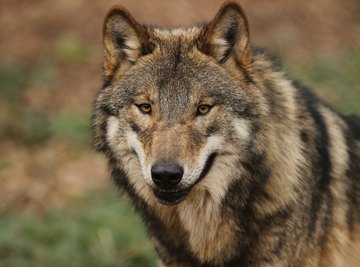
The canidae family has 34 living species, with four of those species commonly known as wolves. Wolves tend to be pack animals, living and hunting in groups. In most of their range, they are classified as a top predator. Several species of wolf, because of hunting and habitat loss, are considered endangered and are protected by law.
Gray Wolf
The gray wolf, or canis lupus, once ranged throughout the Northern Hemisphere but today ranges only in few places in the northern U.S., Canada, Mexico, Europe and Asia. It is the largest of all wolf species, growing to 51 inches in length and up to 176 lbs. Worldwide, a number of subspecies of gray wolf can be found such as the Arctic wolf, Italian wolf, Indian wolf and the Russian wolf. The domestic dog is also a subspecies of the gray wolf, as is the Australian dingo.
Red Wolf
The red wolf is one of the most endangered wolf species. At one time it lived throughout the southeastern U.S., but is now only found, in the wild, in a small range in North Carolina. It is similar to the gray wolf, but much smaller. It is also similar in length, but is more slender weighing around 88 lbs. Its legs and ears are longer than those of the gray wolf. It has reddish brown fur that is shorter than its gray cousins.
Ethiopian Wolf
The Ethiopian wolf is a rare endangered species that lives in only seven mountain ranges in the African nation of Ethiopia. Hunting, rabies and cross-breeding with domestic dogs have caused the wolf to become endangered. It is a slender type of wolf that grows to around 40 inches, nose to tail, and weighs up to 42 lbs. Like most wolves, the species lives in a pack but tends to hunt alone and only uses the pack to maintain territory.
Maned Wolf
The maned wolf looks like a fox with long legs. It lives in South America where it is the largest native canid species. It is taller and longer than the gray wolf, but weighs less at around 50 lbs., on average. It does not live in packs like other wolves but is more solitary like foxes. It also hunts like a fox, using a stalking and pouncing style.
References
- University of Michigan Museum of Zoology; Canis Lupus; Tanya Dewey
- University of Michigan Museum of Zoology; Canis Rufus; Michael Mulheisen
- University of Michigan Museum of Zoology; Canis Simensis; Andrew Bunker
- University of Michigan Museum of Zoology; Chrysocyon Brachyurus; Antonia Gorog
- Wildlife at Animal Corner: Wolf Species
- Defenders of Wildlife: Red Wolf