

Whether on land or water, the American Civil War saw many advances in transportation. As railroads took on a critical role and ships became more protected, both the North and the South benefited from time-tested and innovative advances in transportation to move troops, care for the wounded and create formidable forces in battle.
Marching
Railroads may have been an efficient means of travel, but marching remained the main way that troops were transported from one place to the next. On an average day, soldiers might cover about 15 miles and, when forced to march, might march as much as 30 miles in a day. Union soldiers carried between 44 and 50 pounds while some Confederate soldiers might carry as little as 30 pounds, due to comparatively fewer supplies. "Corduroy" roads were often used so soldiers could cover muddy or low areas -- they were created by lying logs side-by-side across roads, similar to corduroy cloth, which provided traction for soldiers and wagons.
Railroads
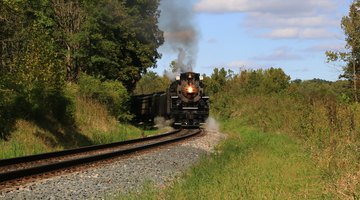
The Civil War marked the first time that railroads were used in an American conflict. Railroads had developed quickly during the first half of the 19th century, the amount of track across the country tripling between 1850 and 1860. During the war, both the North and the South used railroads to transport supplies and men, though the North had better equipment and more track. Because of the convenience and advantages for both sides, rail stations soon became the targets of attack and the rails themselves objects of destruction. Railroads proved vital to generals in the conflict, delivering Confederate troops to the battlefield at a critical juncture in the First Battle of Manassas, or Bull Run, for example.
On the Battlefield
Transportation on the battlefield, specifically of wounded soldiers, was transformed and gained efficiency throughout the war. Union Major Jonathan Letterman developed the Ambulance Corps. Trained men would carry stretchers and load wounded soldiers onto wagons to be taken to field stations for treatment and, where possible, to hospitals. Prior to this development, wounded men would sometimes suffer on the battlefield for days. After Letterman's innovations, soldiers could be recovered much more quickly. At battle of Antietam, with over 23,000 casualties, all wounded Union soldiers were retrieved within 24 hours.
On the Water
Steamboats served as a helpful form of transportation. While railroads were vulnerable to attack, a river was an unstoppable force as long as the boat survived the journey. Ships of varying sizes could carry between 100 and 1,700 tons. Estimates by a U.S. Army supply officer are that a boat on the Ohio River carrying 500 tons could provide supplies for 40,000 men and 18,000 horses for two days. Steamships ferrying Union troops played an important role in allowing the Union to aggressively pursue its campaign on the Mississippi and Tennessee rivers, among others. Ships bringing Union reinforcements after the first bloody day at the battle of Shiloh provided the margin for victory for General Grant the following day. And while both sides used both steamboats and sailing ships made from wood, ships covered in armor, known as ironclads, were used for the first time.
Horses and Mules
Both the North and the South used horses as a speedier means of transportation than marching and as an advantage in battle. Cavalry were also employed to conduct raids, often severing telegraph lines and destroying train tracks to cause confusion. As armies traveled farther from railways, horses and mules also became more and more critical to logistics. Used to haul wagons and cannons, these animals were vital sources of transportation for men, food -- both for themselves and the soldiers -- and other supplies.
Related Articles




References
- PBS.org: Civil War Innovations
- Technology and the Civil War; by Shane Mountjoy
- The Civil War Trust: Jonathan Letterman
- Cavalry Raids of the Civil War; by Robert W. Black
- The New Republic: How Much Did a Civil War Soldier Carry?
- Fairfax Times: Historians log potential Civil War history in Fairfax
- The Daily Herald: Moving an Army - Civil War Logistics