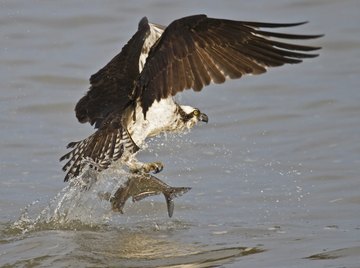

When we think of the food chain at its most simplified, we tend to imagine meat-eaters preying on plant-eaters: a leopard throttling a gazelle, or a Tyrannosaurus (carefully) bringing down a Triceratops. Actually, many carnivorous animals also happily eat fellow carnivores, a habit that classifies them as tertiary consumers. As you might expect, tertiary consumers account for some of the most impressive critters on the planet, and the “top dogs,” if you will, of a local food web – though ultimately even they fall on the dinner plate of scavengers and decomposers.
TL;DR (Too Long; Didn't Read)
TL;DR (Too Long; Didn't Read)
Tertiary consumers are: carnivorous animals that prey on secondary consumers, which themselves are predators of primary consumers.
Food Chains and Trophic Levels
Food chains and energy pyramids describe the energetic relationships between organisms in an ecosystem. The relative position of a given organism within that food chain or pyramid is called its "trophic level." Basic trophic levels include primary producers, primary consumers, secondary consumers and tertiary consumers. Primary producers – green plants, for most terrestrial communities – convert solar energy into food energy; they're "autotrophs," capable of making their own food. Primary consumers eat primary producers to obtain that food energy, which they can't manufacture for themselves. Primary consumer examples include any number of herbivores, from beetles to bison. Secondary consumers eat the primary producers. Tertiary consumers eat the secondary consumers, though they may also feed on primary consumers, or even – in the case of an omnivore such as a brown bear – primary producers as well.
Food Chain Examples
Tertiary consumers come in all shapes and sizes. A tiny sardine scarfing on tinier zooplankton is a tertiary consumer, and so is an enormous great white shark chomping a swordfish or sea lion. Most terrestrial tertiary consumers also play the role of secondary consumers by feeding at multiple trophic levels. For example, a great horned owl serves as secondary consumer when it preys on a plant-eating cottontail (a primary consumer) and as a tertiary consumer when it makes a meal of a meat-eating skunk or hawk. Other tertiary consumers – omnivores, which consume both plants and animals – feed at three trophic levels by adding primary producers to their diet. In a given week, a red fox, for example, might nibble ripe berries from a shrub (primary producer), pounce on a vole (primary consumer) and snatch a weasel (secondary consumer). These food chain examples show both the variety of tertiary consumers in nature and the variable structure of many food chains.
Tertiary Consumers as Apex Predators
As the sardine example suggests, many tertiary consumers are themselves prey for other tertiary consumers, but some occupy the top rung of the food chain as "apex predators," which aren’t actively preyed upon by any other creatures. Examples of such formidable beasts include orcas (killer whales), golden eagles, lions, polar bears and Indo-Pacific crocodiles. Of course, many organisms consume these apex predators after they’ve died: from scavenging birds and mammals to insects, fungi, bacteria and other decomposers.
References
About the Author
Ethan Shaw is an independent naturalist and freelance outdoors/nature writer based in Oregon. He holds a B.S. in Wildlife Ecology and a graduate certificate in G.I.S. from the University of Wisconsin-Madison. His primary interests from both a fieldwork and writing perspective include landscape ecology, geomorphology, the classification of ecosystems, biogeography, wildlife/habitat relationships, and historical ecology. He’s written for a variety of outlets, including Earth Touch News, RootsRated, Backpacker, Terrain.org, and Atlas Obscura, and is presently working on a field guide.
Photo Credits
LorraineHudgins/iStock/Getty Images