


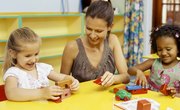
Children respond well to positive reinforcement. When a child misbehaves or does not follow directions, yelling or using negative language often does little to correct the behavior in the long run. Teachers can learn positive reinforcement techniques to get children to exhibit appropriate behaviors, such as using positive phrasing, offering choices, presenting problem-solving opportunities and creating an environment conducive to the behaviors children are expected to exhibit.
Positive Phrasing
Whenever giving a child instructions, refrain from using the word "don't." Children often tune out negative instructions but will respond to statements of request. Instead of saying "Don't touch that," say "Please leave that alone" or "Please put that toy away." A phrase such as "Don't leave your crayons on the table" can be reworded as "Your crayons belong in the box." Encourage children in positive behaviors through praise. If Sally is putting away her crayons and Mary is not, say "I really like the way Sally is putting away her crayons" to motivate Mary to exhibit the appropriate behavior. When Mary puts away her crayons, provide her with the same praise.
Offering Choices
Not only does offering children choices provide them with the opportunity to develop mentally, it allows them to take ownership of an activity or behavior. Allow children to make simple choices, such as what kind of juice to have for a snack or which book to read. When creating artwork, children can choose between markers and crayons and other art supplies. Provide time in the classroom during which children can choose to play at different stations, rather than requiring all children to complete the same activity at the same time.
Problem-Solving Strategies
Telling a child he is doing something wrong can often have a negative impact. If a child is completing an activity incorrectly or is not getting the desired results, explain the situation to the child and work together with solutions to fix the problem. For example, if a child volunteers to clean off the table and just wipes all of the crumbs onto the floor, say to the child "Thank you for cleaning the table, but now we have crumbs all over the floor. What can we do to clean them up?" This approach can also be used when a child is angry or sad. If a child is angry because someone else took a toy she wanted to play with, say something like "I understand you are angry because she took your toy. Are there any other toys that can make you happy?" or "How about if she plays with the toy for five minutes and when the timer goes off, you can have the toy? Would that solve the problem?"
Changing the Environment
Often children exhibit negative behaviors simply because of the environment surrounding them. For example, a classroom without a clearly labeled system of organization for toys, crayons and other supplies is more likely to be messy than one with a system in which children participate and understand. Whenever a child spills something, does not pick up after herself or refuses to take a nap, for example, consider the environment and changes that could be made to prevent the problem. Did the child spill his milk because the cup was too flimsy? Were toys not picked up because the toy bin was not easily accessible? Is nap time not working because the classroom is too loud or too bright?
Related Articles






Writer Bio
Stacy Zeiger began writing in 2000 for "Suburban News Publication" in Ohio and has expanded to teaching writing as an eighth grade English teacher. Zeiger completed creative writing course work at Miami University and holds a B.A. in English and a M.Ed. in secondary education from Ohio State.