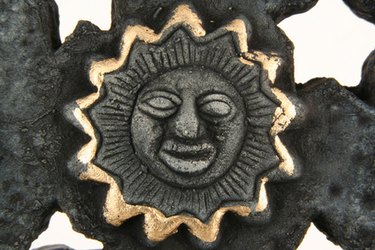
The Aztec were ancient people who lived in Mexico during the 14th to 16th centuries. They are considered to have been a highly evolved civilization, having their own numerical system, calendar, and social structure. Much of their art remains in the early 21st century, and it is admired for its animal symbolism and storytelling. Sculpture, pictographs, pottery and drawings are the most common Aztec arts. Their pieces were brightly colored using crushed minerals, vegetables, insects and shells.
Red
Video of the Day
Red is one of the most common colors in Aztec art. It was used in pictographs, pottery, masks, jewelry and body adornments. The color red was derived from the cochineal insect. When a cochineal is crushed its body can be made into a red dye. For certain religious rituals Aztecs were also known to paint their faces red with their own blood.
Video of the Day
Yellow
Yellow is commonly found in Aztec art. It is used in pictographs to color people and record events; one of the most well known religious artifacts that features a lot of yellow is the Codex Magliabechiano. The sun is a predominant symbol in much of Aztec art and is always painted in a brightly colored yellow.
Turquoise
Turquoise is found in many prominent Aztec pieces, especially those symbolizing religious figures. Masks were adorned in turquoise because the Aztecs believed the stone to have amuletic powers. The Skull of the Smoking Mirror and the Mosaic of the Double Headed Serpent are two well known Aztec pieces made of turquoise.