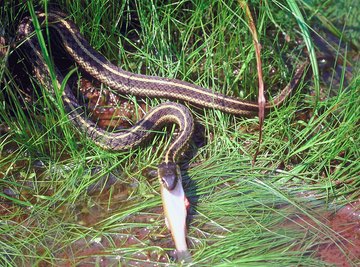
Georgia's climate is warm for much of the year, making it a suitable environment for cold-blooded snakes. Most of Georgia's snakes are nonvenomous members of the reptile family, Colubridae. Georgia's nonvenomous snakes rely on constriction to subdue their prey.
Pit vipers and eastern coral snakes make up most of the roster for Georgia snake identification. Some of Georgia's nonvenomous snakes look similar to the venomous species, so it's important to understand the differences.
Pit Vipers
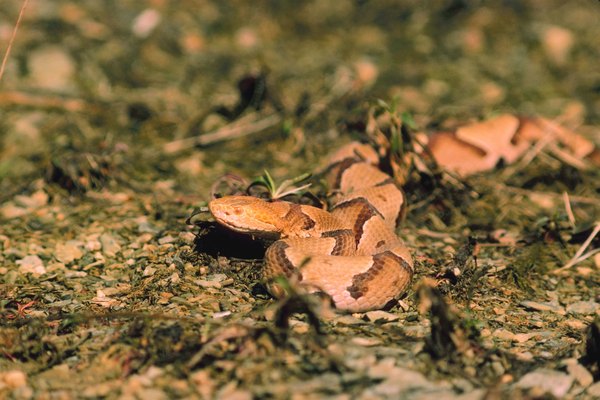
Georgia's venomous pit vipers, members of the Viperidae family, include the pygmy rattlesnake, eastern diamondback rattlesnake, copperhead and cottonmouth. Viperidae have slit-shaped eye pupils and triangular heads. These snakes have facial pits between their eyes and nostrils, which is how they get their name.
These pits have sensors that detect heat within warm-blooded prey such as small mice, squirrels and rabbits. Pit vipers have two large, hollow fangs filled with venom; the fangs are attached to the roof of their mouth near the front. Even these baby snakes in Georgia are dangerous if they bite, so be wary.
Eastern Coral Snake

The eastern coral snake (Micrurus fulvius), another venomous snake, is the only Georgia snake from the Elapidae family. Unlike pit vipers, the venomous eastern corals have round-shaped pupils. Eastern corals differ from Georgia's other venomous snakes by the shorter length of their fangs.
When these snakes bite, they do not control the amount of venom they inject. These snakes have red-yellow-black patterns on their skin. Eastern coral snakes spend most of their time underneath leaves or logs and do not often emerge into open areas, according to the University of Georgia Museum of Natural History.
King Snakes
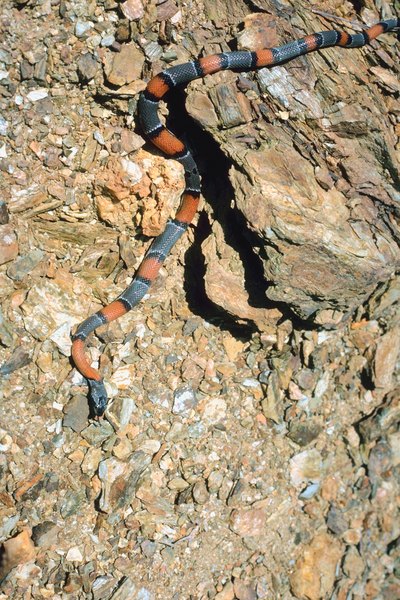
King snakes are nonvenomous snakes that belong to the Lampropeltis genus. Three king snakes live in Georgia: the milk snake, mole king snake and eastern king snake. A subspecies of the milk snake, the scarlet king snake, also lives in Georgia. King snakes are so named because they eat other snakes, including venomous species.
These snakes are immune to the venom of the eastern coral snake and pit viper. The longest king snake in Georgia is the eastern king snake, which reaches 4 feet long. Humans mistake milk snakes and scarlet king snakes for eastern corals because of their similar skin patterns. However, milk snakes and scarlet king snakes have red-black-yellow or -white patterns.
Water Snakes
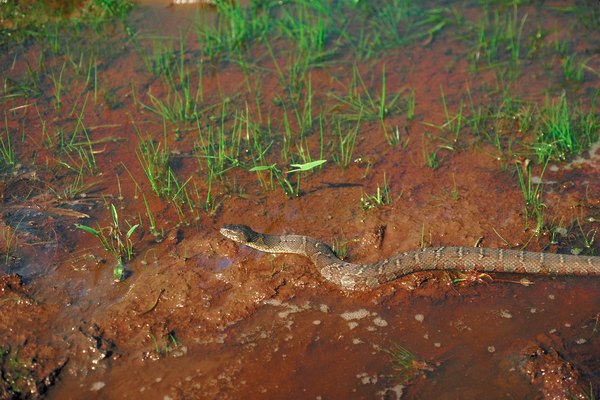
Georgia is home to five nonvenomous water snakes, all members the Nerodia genus: banded, brown, redbelly, green and northern. Water snakes (even the baby snakes in Georgia) are able to dive and swim underwater. Northern and banded water snakes have brown markings on their skin, which give them a striking resemblance to copperheads or cottonmouths. The eyes of brown water snakes are almost on the top of their heads.
Oak Snake
Oak snakes are a bit rarer in terms of Georgia snake identification as they're mainly found in Florida and other neighboring states. However, you can find oak snakes in southern Georgia.
Named for their skin camouflaging with oak trees, these snakes average 4-5 feet in length with the ability to grow up to 7 feet long. If you see one, you probably don't need to worry: they're known as shy, secretive, and non-aggressive.
If they do bite, they don't have any venom so you don't need to worry about that. Eating mostly small lizards and frogs, they also can eat insects, squirrels, rats and mice. These snakes can live up to 20 years with an average lifespan of 12 years.
Other Nonvenomous Snakes
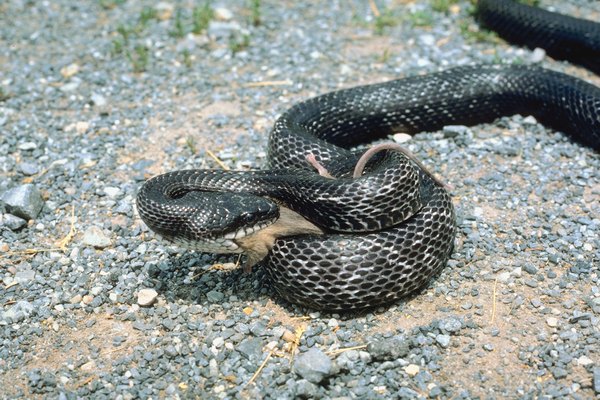
The eastern ribbon and eastern garter are two of the most common snakes in Georgia. Both of these snakes may be identified by the long stripes on their sides; the stripes run lengthwise from head to tail. The slender eastern coachwhip is one of Georgia's longest nonvenomous snakes, at 6 to 7 feet. Other nonvenomous species in Georgia include smooth and rough earth snakes, rat snakes, crayfish snakes, eastern and southern hognose snakes, indigo snakes and black racers.
References
- Georgia Department of Natural Resources -- Wildlife Resources Division: Snakes of Georgia
- University of Georgia Museum of Natural History: Eastern Coral Snake
- University of Georgia -- Savannah River Ecology Laboratory: Eastern Garter Snake; Amelia Gleaton
- Dallas-Fort Worth Herpetological Society: Coachwhips; 2002
- Hunker: Georgia Oak Snakes
About the Author
Skip Davis has been writing professionally since 2005. His work has appeared in "Southern Literary Magazine," on various websites and in graphic panels at the Jackson Zoological Park in Jackson, Miss. Currently living in Southern California, Davis received his Bachelor of Arts in theater at Belhaven College.
Photo Credits
Jupiterimages/Photos.com/Getty Images