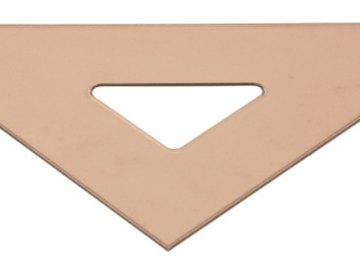
An isosceles triangle is identified by two base angles being of equal proportion, or congruent, and the two opposing sides of those angles being the same length. Therefore, if you know one angle measurement, you can determine the measurements of the other angles using the formula 2a + b = 180. Use a similar formula, Perimeter = 2A + B, to find the perimeter of the isosceles triangle, where A and B are the length of the legs and base. Solve for area just as you would any other triangle using the formula Area = 1/2 B x H, where B is the base and H is the height.
Determining Angle Measurements
Write the formula 2a + b = 180 on a piece of paper. The letter "a" stands for the two congruent angles on the isosceles triangle, and the letter "b" stands for the third angle.
Insert the known measurements into the formula. For instance, if angle "b" measures 90, then the formula would read: 2a + 90 = 180.
Solve the equation for "a" by subtracting 90 from both sides of the equation, with a result of: 2a = 90. Divide both sides by 2; the final result is a = 45.
Solve for the unknown variable when solving the equation for angle measurements.
Solving Perimeter Equations
Determine the length of the triangle sides and insert the measurements into the perimeter formula: Perimeter = 2A + B. As an example, if the two congruent legs are 6 inches long and the base is 4 inches, then the formula reads: Perimeter = 2(6) + 4.
Solve the equation using the measurements. In the instance of Perimeter = 2(6) + 4, the solution is Perimeter = 16.
Solve for the unknown value when you know the measurements of two of the sides and the perimeter. For instance, if you know both legs measure 8 inches and the perimeter is 22 inches, then the equation for solution is: 22 = 2(8) + B. Multiply 2 x 8 for a product of 16. Subtract 16 from both sides of the equation to solve for B. The final solution for the equation is 6 = B.
Solve for Area
- Pencil
- Paper
- Calculator (optional)
Calculate the area of an isosceles triangle with the formula A = 1/2 B x H, with A representing the area, B representing the base and H representing the height.
Substitute the known values of the isosceles triangle into the formula. For instance, if the base of the isosceles triangle is 8 cm and the height is 26 cm, then the equation is area = 1/2 (8 x 26).
Solve the equation for the area. In this example, the equation is A = 1/2 x 208. The solution is A = 104 cm.
Things You'll Need
References
About the Author
Julie Richards is a freelance writer from Ohio. She has been writing poetry and short stories for over 30 years, and published a variety of e-books and articles on gardening, small business and farming. She is currently enrolled at Kent State University completing her bachelor's degree in English.
Photo Credits
Hemera Technologies/PhotoObjects.net/Getty Images