
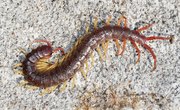
Centipedes have the basic body shape of a worm, but they also have legs and fangs, often with a venomous bite that can be very painful. The name means "hundred legged," but they generally have only 10 to 30 pairs of legs, with one pair attached to each segment. They are carnivorous and tend to prey on small invertebrates. There are many types of California centipedes, many of which live outside the state as well.
TL;DR (Too Long; Didn't Read)
There are four types of centipedes that live in California: the tiger, house, soil and stone centipedes.
Tiger Centipede
The Scolopendra polymorpha, or tiger centipede, reaches 15 cm in length or more. It may possess a number of colors on its exoskeleton including blue, green, brown, black, yellow and orange . These centipedes are not particularly aggressive and can be kept in captivity, but they will occasionally bite. Though not deadly to humans, the bite can be very painful. They feed primarily on insects and prefer an arid environment.
Soil Centipede
Soil or geophilomorpha centipedes are long, thin centipedes with flattened segments and 27 or more leg pairs. Like other centipedes, they are carnivorous, but do not have the ability to bite humans or inject venom. Instead, they feed mostly on insect larvae. They burrow in the soil, breaking it up and aerating it. They tend to lay their eggs in rotted wood or in the soil and lay between 15 and 60 at a time. There are over 1,200 varieties.
House Centipede
The house or scutigeromorpha centipede ranges throughout California and is very common. Unlike other centipedes, it may live its entire life in a building, as opposed to other centipedes which prefer to live outside. House centipedes favor damp, dark environments like cellars, crawlspaces and closets. They eat other pests but lay their eggs in homes. They have very long legs. They will bite but are not particularly aggressive.
Stone Centipede
The stone centipede, or lithobimorpha, is among the oldest species on the planet. They range across the world in various forms. They have 15 pair of legs and live under rocks and logs.
References
About the Author
Sean Kotz has been writing professionally since 1988 and is a regular columnist for the Roanoke Times. He has also written for the Blue Ridge Business Journal, The Roanoker, 50 Plus, and Prehistoric Times, among others. He holds a Master of Arts in literature from Virginia Tech.