Things You'll Need
3 tapered tip applicator bottles
Permanent marker
Rubber gloves
Facemask
Protective goggles
Old clothing
Potassium dichromate salts
Balance (gram weights)
Graduated cylinders
Nitric acid
Distilled water
Hydrochloric acid
Glass stirring rod
Gold piece
Metal file
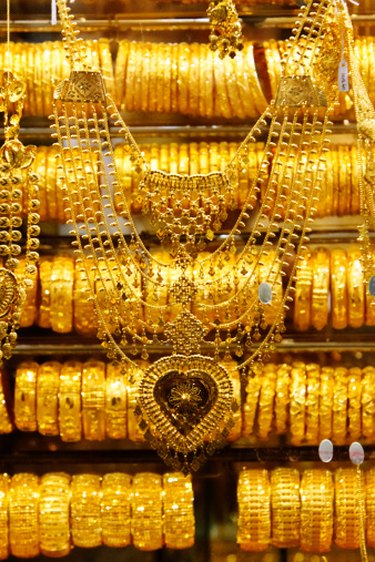
Professional jewelers and jewelry appraisers often use gold acid tests to determine gold jewelry's value. Different acids react differently when dripped on specific base metals, allowing you to tell how pure your gold is. Since gold is so soft, most gold jewelry today is made of an alloy of some kind. Base metals, like copper, brass, nickel and tin make gold more durable and cheaper to manufacture. Knowing your acid test results can help you identify dishonest appraisals and gold suppliers.
Step 1
Label your three bottles with the ingredients inside. Write potassium dichromate salts, nitric acid and distilled water on the first; hydrochloric acid, nitric acid and distilled water on the second; and nitric and hydrochloric acid on the third.
Video of the Day
Step 2
Label the bottles 1, 2, and 3, writing the numbers on the caps, also. It's essential that you not mix up the caps. Mixing these chemicals in the wrong proportions could create very destructive acids and gasses.
Step 3
Put on rubber gloves, protective goggles and a facemask. Wear old clothing that you wouldn't mind staining or tearing.
Step 4
Measure out 10 grams of potassium dichromate salts on a balance. Add it to the first bottle, along with .75 ounces of nitric acid and .25 ounces of distilled water. Stir with a glass stirring rod and cap.
Step 5
Rinse the glass stirring rod under cool water for at least 60 seconds. You must do this between mixing up each bottle of acid test.
Step 6
Add 100 milliliters of hydrochloric acid and 24 milliliters of distilled water to the second bottle. Stir with a glass rod and rinse the glass rod thoroughly.
Step 7
Add 3 ounces of hydrochloric acid and 1 ounce of nitric acid to the last bottle. Mix thoroughly and rinse the glass rod. Most graduated cylinders are marked with both standard and metric measurements.
Step 8
File three notches into your gold piece, spacing them about .5 inches apart. Drip a single drop of one solution onto each notch.
Step 9
Examine the notches. Pure gold will not change color, but brass will turn brown, copper becomes light brown, nickel turns blue and both tin and lead turn yellow. Each solution tests for different alloys; you'll be able to tell which combination of metals your gold piece really is.
Warning
Always use extreme caution when working with acids, especially hydrochloric acid. Never touch the acid with your bare skin. If you get any acid on you, rinse the area immediately with cool water and contact emergency services. Never mix acid test ingredients in proportions other than those specified. Improper proportions could result in very caustic acids and gasses.
Video of the Day