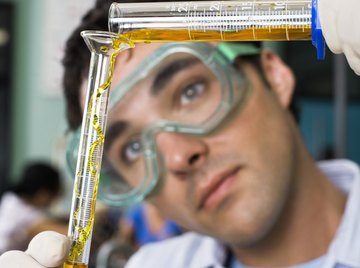
High school students may be required to mix chemical solutions when encountering laboratory experiments. It is important to properly mix chemicals into a useful chemical solution. Some solutions are calculated as percent weight, w/v, or percent volume, v/v. Others are based on molarity or moles per liter. The chemical that is diluted or dissolved is called the solute and the liquid medium is the solvent. Understanding proper methods for mixing chemicals into solution is important for students to conduct a successful laboratory experiment.
Solutions Based on Percentage
Determine if the percent solution is given as w/v or v/v. Solutions that are based on w/v measurements are generally a solid chemical dissolved into a liquid solvent such as water. Solutions based on v/v measurements are liquid diluted into a liquid.
Calculate appropriate v/v dilution using the formula C1V1 = C2V2 where C represents the concentration of the solute, and V represents volume in milliliters or ml. An example would be combining 95 percent ethanol with water to mix 100 ml of 70 percent ethanol. The calculation is 95% X V1 = 70% X 100ml. The unknown volume is 73.6 ml of 95 percent ethanol with 26.4 ml of water to make 100 ml.
Pour liquid solute into graduated cylinder or volumetric flask before adding solvent. Graduated cylinders and volumetric flask are used because measurements are more accurate than with beakers. Beakers are generally used for approximate volumes and mixing.
Weigh appropriate solid chemical to mix a w/v solution. A 10 percent solution is equal to 10 grams dry chemical in a final volume of 100 ml. The solute adds volume and is considered in the final volume of solution.
Add the solid solute into the beaker first before adding the solvent. This will avoid adding excess solvent to the solution. You should allow dry solute to dissolve in solvent first before adding to the total volume. Pour solution into a graduated cylinder or volumetric flask and add solvent to achieve final volume.
Solutions Calculated Using Molarity
Determine if the solute is solid or in liquid form. The molarity, or M, of a liquid solute is generally provided and may only require simple dilution. A solid solute would require accurate weight measurement.
Calculate liquid solute dilution using the C1V1 = C2V2 formula. Diluting 5M sodium chloride, NaCl, to make 100 ml of 1 M solution would be calculated as 5M X V1 = 1M X 100 ml. The value for V1 is 20 ml with 80 ml water for a final volume of 100 ml.
Pour liquid solute into graduated cylinder or volumetric flask before adding solvent. Then add solvent to achieve desired volume.
Determine the molecular weight, MW of the dry solute. The molecular weight will be provided on the chemical container and Material Safety Data Sheet, or MSDS. The molecular weight is equal to 1 mole. Sodium Chloride has a molecular weight of 58.4 grams. Therefore, 58.4 grams dissolved in a total volume of 1 liter is equal to a 1M solution.
Calculate the gram weight of the solute to make 1 liter of solution. You can calculate gram weight from the given molarity of the solution using the formula MW X molarity. A 2M solution of sodium chloride requires 58.4 grams X 2M, or 116.8 grams in 1 liter.
Determine total volume required for the experiment. The experimental method does not necessarily require 1 liter of solution. It may require only 100 ml or 0.1 liter. The gram weight required to mix a 2M sodium chloride solution in 100 ml is 0.1 liter X 116.8 gram, or 11.7 grams of sodium chloride.
Add the solid solute into a beaker first before adding the solvent. Add enough solvent to allow the solid to dissolve. Pour the solution into a graduated cylinder or volumetric flask and add solvent to achieve final volume.
Adjusting pH of the Solution
- Analytical balance
- Graduated cylinders
- Graduated beaker or Erlenmeyer flask
- pH meter or pH indicator paper
- Volumetric flask
Volumetric flasks are accurate devices for measuring final volume. Graduated cylinders can also be used if volumetric flasks are not available. Beakers and Erlenmeyer flasks are not very accurate for measuring volume but are generally used for mixing.
You should always use appropriate safety equipment when mixing chemical solutions including eye protection. Acids and bases used to adjust pH can be harmful to the eyes. Other chemicals produce harmful fumes and may require a fume hood. The MSDS is usually provided with the chemical or available online and provides important safety information.
Measure the pH of the final solution using pH meter or pH paper. A pH meter provides the most accurate measurement. However, pH paper can suffice if a meter is not available. An example of a buffer is sodium chloride, NaCl in water.
Determine if the pH is above, more basic, or below, more acidic than the required pH. NaCl dissolves in water to give a neutral pH of 7.
Add reagent to change pH to the desired value. The reagent used to change pH should be fairly dilute and not alter chemical composition of the solution. Hydrochloric acid, 0.1M HCl, would be used to lower pH and sodium hydroxide, 0.1M NaOH, would be used to raise pH. Combining HCl and NaOH in water produces sodium chloride.
Things You'll Need
Tips
Warnings
References
Tips
- Volumetric flasks are accurate devices for measuring final volume. Graduated cylinders can also be used if volumetric flasks are not available. Beakers and Erlenmeyer flasks are not very accurate for measuring volume but are generally used for mixing.
Warnings
- You should always use appropriate safety equipment when mixing chemical solutions including eye protection. Acids and bases used to adjust pH can be harmful to the eyes. Other chemicals produce harmful fumes and may require a fume hood. The MSDS is usually provided with the chemical or available online and provides important safety information.
About the Author
Douglas Bintzler began freelance writing in 2010. He has over 20 years writing scientific content for websites, newsletters and manuals for an academic research audience. His research publications have appeared in the "Journal of Biotechnology." Bintzler's education includes degrees in zoology, chemistry and post-graduate studies in genetics.
Photo Credits
Creatas Images/Creatas/Getty Images